

TLDR
Summary
In this episode of The Agency Podcast, Sam Gaudet, the Creative Director for Dan Martell, deconstructs the systematic approach used to scale Martell’s personal brand from 10,000 to over 8.8 million followers. Gaudet argues that successful content creation is a manufacturing process rather than a purely artistic endeavor. He details the transition from a lean team of six to a robust media engine of twelve, emphasizing that scaling requires "artifacts"—tangible frameworks and principles that allow a team to execute a founder's vision without constant oversight.
Gaudet introduces several proprietary frameworks, including the H.E.I.T. Framework for scripting (Hook, Explain, Illustration, and Takeaway) and the Five Ms (Model, Map, Make, Multiply, and Measure) for operational workflow. He explains the "Lake Method" of distribution, which favors platform-specific optimization over a traditional waterfall strategy. Throughout the conversation, Gaudet emphasizes the importance of "Results in Advance" (R.I.A.), the psychology of "Frustrated Fred" (the Ideal Customer Profile), and the necessity of focusing on high-demand topics over high-end editing to achieve viral growth and sustainable brand authority.
Highlights
- The Manufacturing Mindset: Content creation should be treated as a manufacturing line with raw materials (ideas) and finished goods (videos) rather than a sporadic creative spark.
- H.E.I.T. Framework: A reliable structure for educational content consisting of a Hook (context, contrarian take, and intrigue), Explanation of the concept, Illustration through analogy or story, and a clear Lesson or Takeaway.
- The Power of Artifacts: Leaders must create written principles and frameworks to avoid the "telephone game" and allow the team to make decisions based on established standards rather than individual preferences.
- CCN Fit: To maximize reach, content must resonate with the Core audience (buyers), Casual audience (followers), and New audience (strangers) simultaneously.
- Model then Modify: 70% of content should be based on proven formats and high-demand topics, 20% on slight variations, and only 10% on high-risk innovation.
- The Lake Method vs. Waterfall: Instead of forcing content down a linear path, create a "lake" of assets where channel owners can "fish" for the specific content that best suits their platform's unique algorithm.
- Results in Advance (R.I.A.): The primary goal of a personal brand is to provide enough free value that the viewer achieves a result before they ever pay for a product or service.
- View-to-Follower Ratio: A critical metric for health; Gaudet suggests aiming for a 1% conversion rate from a view to a follower to ensure the brand is building an owned asset rather than just chasing temporary attention.
- The 15% Rule for Goals: Effective leaders set goals that the team hits within a 15% margin (above or below); missing by more suggests poor goal-setting, while over-performing by too much indicates the bar was set too low.
Transcript
00:00:00
Sam, you've helped Dan Martell scale his media empire from 10,000 [music] subscribers to 8.8 million subscribers across all platforms. And you've gone from rock bottom to Dan buying you a Porsche and handing you the keys. In every video, there's a hook, but there's three C's that you need to nail in every single hook. The first one is context. What is actually happening in the video? The second one is a contrarian take. The last one is create intrigue so that people when they click
00:00:29
on that video and they watch the first 30 seconds, they're hooked and they're addicted to the video because you subconsciously hack their brain. A lot of people think that making content is hard and it's not hard if you have a framework. And if you have a framework, it's kind of like building a puzzle with having the picture right next to you. And once you see this, you can't unsee it. You'll see every single big creator use the same framework if they're educating people on a topic. So
00:00:54
don't sit there, sit on your hands and not take action just because you don't know where to start. Just start somewhere and on that journey you'll figure out where you're going. People that are prolific, that are rich, that made great things in the world, they're normal people. And if you put your head down, you will achieve greatness. [music] If somebody takes that framework, doesn't credit me, and shares it on their Instagram page, good. Cuz I care more about putting that message out in
00:01:15
the world. And if that means somebody else has to platform that message, then I'm okay with it. Like I will give you the real real right now. Like this is the [ __ ] that nobody else is going to talk about in the personal brand space. Uh no media team is going to admit to this. >> This episode is brought to you by Wix Studio. Here at the agency podcast, we're building a community and we would love for you guys to be a part of [music] it. So we would love to hear from you. What are you enjoying the most? What would
00:01:44
you like to see more of? And what do you think might be missing? Drop a comment. Make sure you subscribe. And now on with the show. Sam, welcome to the agency podcast. >> Thanks for having me, Dan. This is amazing. >> I'm just going to read a brief monologue here just to I guess set the stage and then super excited to unpack everything that you've accomplished as well as your frameworks, which I think are just freaking awesome, man. From what we've been talking about, Sam, you've helped
00:02:11
Dan Martell scale his media empire from 10,000 subscribers to 8.8 million subscribers across all platforms. You're on a mission to make Dan number one as the number one entrepreneur on the internet. And you've gone from rock bottom to Dan buying you a Porsche and handing you the keys. You're the architect behind the verality on his channel. >> And today we're going to deconstruct it. So, dude, I'm pumped to have you here. >> I'm excited, dude. That's a great
00:02:40
monologue. That's a great like intro. Get into it. Open some loops for people. We'll talk about the psychology behind what Dane just did. And uh >> okay, unpack it then, dude. Because I would love to know what you're taking away from what I'm what I'm reading out just here. >> Well, extreme proof, right? Whenever you start a video, you want to show people that the person you're listening to is the person you want to learn from, right? So, the fact that you said 10,000
00:03:01
to 8.8 million. Nobody else can say that, right? That's been on a media team for eight years with the same person and got him results. So, that is like what made, you know, Sam me unique to like listen to. And then the second part is, you know, saying rock bottom, which obviously opens the loop of like, what was my rock bottom? Wink wink. And then buying a Porsche. It's like, what would what did Sam need to do? >> Yeah. Now we're like, if you're watching this, you're like, I got to close the
00:03:27
loop. >> Yeah. >> So, you're going to watch the whole thing now. Might as well. >> You're hooked. You might as well strap yourself in. Uh, so I guess to kick things off here, dude, and I love how you just quickly like unravel what I was doing. >> It was great. How did you end up working for someone like Dan Martell at the age of 16? >> Yeah. So, what not a lot of people realize is that I started that young. And when people meet me today, I'm 24 and they say like, "Dude, like I wasn't
00:03:53
doing anything like you at 24, but they don't realize that I've been in content 10 years, that I've been on dance team for eight years, and that I've been like seriously, you know, implementing the strategies that I've learned for about six years, right? And those six years, you know, the first four were, you know, mediocre, but then the last two were insane and parabolic. And a lot of people forget that, you know, a lot of gains can be made in a couple years if you set up the foundation first. So,
00:04:15
with all that being said, at 16, um, my dad was an entrepreneur, extremely blessed to have the dad that I got. And he always had books laying around whenever I I I grew up. I would, you know, pull books off the shelf. Rich Dad, Poor Dad, The Monk Who Sold Ferrari. Um, investing for kids, you know. um uh the 4-hour work week, like all these, you know, business books that have been around for ages. Rich, uh uh Think and Grow Rich, right, was one of the first books that I I I I read. There's a picture of me reading Think
00:04:46
and Grow Rich at at 14. And so, I was always around that stuff. And I remember one day Dan or not Dan, my dad calls me into his office and he says, "Check this guy out." And it was a YouTube video of Dan eight years ago >> back when he was fat. >> Back when he was fat. [laughter] And he was teaching uh people how to grow a SAS business. >> Wow. >> And my dad was like, "You should really listen to this guy. Like he's a smart guy. He's talking about business." And
00:05:14
>> he was in my city at the time. And so that was the spark that brought me to Dan Dan's world, Dan Martell's world. And I remember I told my dad like if there's any way I could get connected to whoever in his space um let me know. And uh you know luckily my dad knew of his videographer at the time and he made that intro and then I I basically went up to his videographer and I said dude like I will do whatever it takes to work for you and under you. And uh and that was the start of my journey. And I
00:05:45
started as a video editor, very technical, very introvert, 8 hour days, head headphones on, right? Like super in the weeds. And then obviously moved up into the organization, which is probably stuff that we can hit on this podcast. Uh but was extremely blessed that I was able to kind of like show my skills at every stage and um get to the point where, you know, Dan just handed me the keys to a Porsche and said like, "It's yours." >> Yeah. There's a crazy video on the internet where um yeah, you are quite
00:06:14
clearly emotional. You're not quite sure what's going on. Um but yeah, Dan obviously sees something in you and he gave you >> uh one of his own Porsches that he knew that was your goal. And I understand that you bought a house first. You wanted the Porsche, >> but you wanted to delay your gratification. >> Yeah, it was it was a cool little story cuz Yeah, he >> essentially um we were talking about me buying a car. Obviously, he has a ton of cars. has a fleet of cars and um I wanted to
00:06:41
get a Porsche GT4 cuz my dad's a huge Volkswagen guy, huge Porsche guy. I grew up around it. Um and I wanted to get my own and um it was on my vision board. It's still on my lock screen on my phone and I would keep looking at it, thinking about it. Like this was, you know, 5 years in and at this point I was making decent amount of money, like enough to kind of get it. [snorts] And Dan, you know, nudged me and he's like, "You should get it for yourself. You know, I think it would be really good." um you
00:07:07
know, experience, whatever. Like, you should get your things that get the things that you want, right? Um allow yourself to buy the car. And um I remember I I was just like, I got to I got to buy a house and, you know, I got to kind of like start there. And I think it it it you know, showed Dan quoteunquote who I was and what I what I kind of prioritized. And um I remember when the day that he was going to give me the car, I'd bought the house like two weeks prior and uh kind of like you know all
00:07:37
my money on the house and I thought at the time that he was going to make me buy the car and we went to the cuz we went to to the dealership and I saw it on the turntable and it was my dream car. Keep in mind like I the white GT4 is what I want to get. You know what I mean? And um I'm walking into the dealership. I see the white Porsche on the turntable. We kind of walk around. I thought I knew what was going on. I thought Dan was going to hand me a contract and say like, "Hey, sign on the
00:08:01
dotted line, like put your direct uh uh uh put your kind of like information in there and buy the car." But then yeah, when he gave me the keys and he said, "It's yours." Um yeah, that was extremely emotional moment for me. >> When you think to that moment, like what was going through your head? >> I mean, a lot of things. cuz I think inherently like extreme gratitude for like how generous Dan is, but at the same time like disbelief like you know I can't believe
00:08:29
I'm going to be driving this car. Um and I do think like some people think that you know a car a super car a nice house like all these things are kind of surface level superficial but at the end of the day like the the whole reason I kind of went into business was to have nice things and like be able to kind of like experience that. And um I mean I was extremely grateful that you know he did that for me and you know I still have the car 2 and a half years later and I still drive it every day and I
00:08:53
[ __ ] love it as much as I got it. every day you turn it on just you get that memory in your mind as well% and I think a lot of people for what it's worth don't allow themselves to get nice things like for for myself like >> before that I was kind of the frugal guy saved all my money like made a ton of money and would not spend it right and I think that's kind of the cage that some entrepreneurs put themselves in even like employees that make a lot of money is they don't allow themselves to
00:09:16
actually get nice things and improve their quality of life right where you know another number in the bank account um is just another number and that also taught me the skill of you know not not even investing in things but also investing in yourself which we can get into but like I've spent personally hundreds uh tens of thousands of dollars on my personal development u to actually become a better leader of my personal money right like my money in my bank account because I know that's going to
00:09:43
build me as a better leader entrepreneur you know media person um and it's going to allow me to create more value in the world which you know obviously comes back to me at the end of the day >> and you clearly know what you need to focus on because you've been able to craft and mold yourself to do extraordinary things at such a young age. Dan was telling me a story over dinner the other night that when you were really getting I guess your claws into the business that you were living in his
00:10:10
basement. >> Yeah. >> And discovered a room that he didn't know he had. >> Yeah. >> Can you explain that? >> Yeah. I mean, so two two years ago, 2023, Dan calls me and he said, you know, my book came out. I want to go all in on media and I want you to be part of it. I want you to be my partner and I want you to move to Colona. At the time, Colona is in Canada. I lived on the east coast of Canada. And for everybody watching that doesn't understand how wide Canada is, it's 4,000 km.
00:10:34
>> It's a big place. >> It's a huge place, over 2,000 miles. >> Um, and at the time I was, you know, debating it. And then a couple days later I show up at his doorstep and I said, "Let's do it." And, uh, I brought my buddy Matis, one of my best friends still today. And uh we started Martell Media um which was all about growing Dan's personal brand in his [ __ ] basement with a bunk bed and a electrical room, right? So I was literally like editing videos next to a
00:11:02
water tank in the basement. And uh we laugh about those days because Dan, you know, obviously thought it was ridiculous, right? Like he was like, "It's hilarious that you guys, you know, found this secret room, put your [ __ ] desks in and you're editing videos in my in my basement." Uh but at the same time like that's a lesson about humility right like even today like I'm not above anyone right even though I drive a nice car I have nice things I make a lot of money like I I can still learn and if I
00:11:28
have to I will work next to a water tank right because that's the type of person I am and every single person that that's on my team today is the same way right like we're not above ourselves and I think that's what keeps us hungry and um and I think that's the reason why Martella became what it was because every single person that joined the team after that was 100% that kind of person right? The the kind of people that, you know, if we have to, you know, if if if we have to sleep in an Airbnb, you know,
00:11:53
on the couch, we'll [ __ ] do it, right? Like there's nobody on my team that complains about that stuff because we're all in it for the mission and the vision, which is making Dan number one, and it's going to happen. >> And two things I noticed about your team. One is everyone's jacked, >> and two, everyone's pretty chill and humble for the most part. >> Yeah. Yeah. And and that's a reflection, and like obviously I I've noticed the same thing in your team, right?
00:12:12
Everybody came up sh sh sh sh sh sh sh sh sh sh sh sh sh sh sh sh sh sh sh sh sh sh sh sh sh sh sh sh sh sh sh sh sh sh sh sh sh sh sh sh shook my hand like extremely friendly and that is a reflection of the leader right like you're obviously a very friendly person you you like you invite people into your life you're charismatic like everybody on your team reflected that and for me like that's what I try to instill in my team and you know some of them are jack some of them are on the journey too u
00:12:30
but that's not to say like um it's it's it's not a prerequisite but at the same time like if you hang around people like me and Dan you'll just get better over time right and that's kind of what kind of propagates through the through the business as we scale Now Sam, I want to go deep down the rabbit hole today on how you've been able to play such a significant role in Dan's business, uh, become his partner. Um, and then you've created arguably one of the fastest growing personal brands
00:12:57
on the internet. And I think we're living in an age now where it's no longer about the individual creating the media themselves, but creating a small nucleus or a small team. >> Yeah. So, when you're thinking about content creation and building a personal brand in the world, if you were to kind of open the door on Pandora's box here, like what are the primary things that you think of when you think of personal branding? >> Yeah. I mean, the the primary thing I think about when people say personal
00:13:27
brand is personality, right? Because at the end of the day, like you can't polish [ __ ] If you're a shitty person, you're not going to have a great personal brand, right? That's step one, right? Become a person worth creating a personal brand for. And I think a lot of people skip over that brand. They want to skip the tactics, right? Or like even some of the stuff that I talk about. But at the end of the day, like if you're if you're not somebody who's, you know, achieved
00:13:48
something or is on a journey to achieve something um or is an interesting person and entertaining person, then I would go do the work, right? And I I know that for every single person in my network that is trying, you know what I mean, but is not getting results. I sometimes tell them like, "Hey, like you need just need to become a better communicator, right? Or you just need to go achieve more, right?" And that's not to say like nobody watching this can can start a personal brand if they're just starting
00:14:13
off, but at least have, you know, some sort of unique perspective around the world that makes you unique, right? And that's a lot of the stuff that I talk about um to my team is creating a personal brand is all about what unique perspectives or value do you bring to the market, right? Because at the end of the day, people aren't only going to follow you unless you're an entertainer, right? But a lot of people um in the personal brand world are actually educators. People are only going to
00:14:39
follow you if you give them uh you know actionable advice and also um create like value for them, right? So I think that's like number one is achieve something great and then teach other people how to do it and that is how you're going to build a prolific personal brand. >> You believe that content is useless unless it solves a problem. Why do so many creators avoid solving problems and default to performing instead? I think a lot of people don't have the ability to solve problems for people like I don't
00:15:08
think a lot of people online that um create content don't genuinely solve problems for people in their personal lives, right? Or in their business lives, right? And I think that's why all the creators that you see online, the business the the huge business creators have gotten massive results for their clients and then they take those case studies and stories and then teach them to the market, right? And I think people want to skip over that step and become like an overnight course seller. U but at the end of the
00:15:35
day, you can't people see through that [ __ ] right? You can't fake being a good business person. You can't fake being a good creative. And you'll notice by the way that they talk, right? And um and yeah, I think it's easy to just perform, right, and ed and and entertain people, but to actually give them really clear value. Clear value only comes from doing the reps and being able to dissect what you did and stories and case studies. And we can get into how we leverage those to create good content and get
00:16:04
people to lean in and be addicted to your videos. But that only happens when you're an interesting person, right? Because if if if I was if I hadn't done what I did for Dan, I wouldn't be on this podcast, nobody would listen, right? But because I got some results, you know, great results. Um then people want to lean in and ask why. >> Yeah. So if you think to yourself, um let's say a listener is listening to this right now and they're not quite sure how they solve problems. A lot of
00:16:29
people might not realize that they naturally solve problems. like is there a way to articulate or to even like review what the problems you solve in your business uh that could be replicatable to an audience? Let's say someone's running a successful company. They're like, I'm really good at this company thing. >> How does this correlate to content and how do I >> how do I highlight that? I think people do tend to struggle with how they can close the gap on what the content
00:16:54
material should be and how they run their business. >> So, the whole point of making content is RIA, right? results in advance. >> Ria Ria, >> you want people to get results in advance because if they can get results in advance by listening to your content, executing on the advice that you give them, and then get results, then they're going to lean in and buy your coaching program. They're they're going to buy your your your agency product. They're going to buy your software product,
00:17:19
>> right? So I would always reverse engineer what ask your clients, ask the people in your life, what are you inherently creating in their lives that gives them results and then how can you package that in your content to get people to that watch your content results in advance. And I think people hide behind their frameworks and they want to keep all the cards close to their chess and they don't want to give out all the free [ __ ] because they're hoping they they think they have this
00:17:48
false belief that if I share everything then nobody's going to buy my program. And from what I've seen every single big creator on the internet do in the last 5 years because you know information is commoditized now is the people who share the best stuff are the people who sell the most. And it doesn't matter if it's the same [ __ ] that's in their program and the best stuff because all all people want when they buy things is proximity, right? And if you can get make marketing content that gets results
00:18:14
for people whether they buy your [ __ ] or not, that is how you build a personal brand in today's world, right? So all the stuff that you go on my Instagram, you go watch my videos, that is my internal playbooks that I use with my team to make videos that get us millions and millions of views every single we get 200 million views every single month using those frameworks. And I'm not holding back because I know on the other side of me, even though I'm not selling anything, on the other side of me
00:18:37
sharing those frameworks with other people, I'm going to build a strong brand because nobody else in the content industry is giving them the free the free game like I am. Um, and that that I think if somebody is holding back and they're like, you know, I've got these three frameworks that I don't want to keep close close to my chest because I'm only going to share them with with, you know, my private clients or my my group clients or even, you know, my my uh agency clients. um that is going to hurt
00:19:00
you in the long run because there's going to be other people like me that's going to roll around and give them all the free [ __ ] and they're going to position it. It's going to position me as the expert and you as the the second place. >> So, if you gave something to a client and they frothed it, they loved it. Uh they think it's exceptional, you're saying, "Great, give it away online for free, even just paid you for it." >> 100%. I tell every single person I do,
00:19:21
you know, I do group calls in Quantum and Dan's private coaching uh program and I tell every single person in that room, take my [ __ ] give it to everybody else for free. Like there's no IP, right? In my world, there's, you know, some there's some IP, right? Like I have frameworks and stuff, but like if somebody takes that framework, doesn't credit me, and shares it on their Instagram page, good. I don't care, right? Because I care more about putting that message out in the world. And if
00:19:45
that means somebody else has to platform that message, then I'm okay with it. If you want to grow your agency, you need more than just a website builder. You need Rick Studio, the all-in-one platform that's built to help you scale. Design smarter in a hyperflexible, responsive editor, cherrypicking whatever clients need from pre-built UI elements and templates. Deliver robust backends with built-in e-commerce solutions for every industry, letting self-maintaining infrastructure just run
00:20:16
itself. Stop reinventing the wheel with every project and instead create a sharable design system with reusable assets, apps, and components. Clients growing too fast? No sweat. Wick Studio AI powered CMS lets you turn a single layout into hundreds of additional dynamic pages. It's true. More clients no longer has to mean more chaos. Wix Studio gives you one centralized view of every project and makes real-time collaborations seamless. Do your agency's best work at scale. Build your next project on Wix Studio.
00:20:53
>> Another concept you have here is what you and the team deem as ICP. >> Yeah. >> And we're not talking about insane clown posy. We're talking about [laughter] ideal customer profiles. Um, why is it important when making content to speak to an archetype audience or in your words an ICP? Uh, what is what exactly is it and how can we implement it into our content? >> 100%. Um, and I call I call this core audience sometimes too and all an ICP is is your ideal customer profile and you
00:21:23
get very detailed on who that person is, right? So, we go down to like how old is he? How many kids does he have? You know, what's his struggles? Is he out of shape? Pro a little bit. You know, he loves but hates his team. um he's at about, you know, one to 1.5 million in revenue a year. Um and that person is the person we talk to in most of our content, right? But just like when you go bowling and you hit the pin at the the the front um and you hit it perfectly centered, all the other pins
00:21:48
fall down. So that doesn't mean that our content doesn't help the single mom Stacy that, you know, is is thinking about starting a business or the 18-year-old that um just left university and quit his job to start a business, right? Those people will also be helped. But when we think about who we actually want to help, it's the um frustrated Fred, right? That's what we call him. And he is [ __ ] pissed off at everything, right? And when we make content towards one singular person,
00:22:14
that creates direction, right? And I can talk about the framework that I use um in every single thumbnail, title, script, uh whether it's short form or or long form. There's four things that for every single uh ICP that I've identified for, you know, dance programs or even people that we've helped, um there's four things that I look at. Number one is what what are their hopes? And that's short term, right? What do they hope to to achieve in in in in their lives? And for frustrated Fred, that's they hope to
00:22:41
make money, right? Start a business, make money. Now it's their dreams, right? what what do they actually want? Right? Because you can talk to their hopes and say like here's how to make money, right? Here's how to start a business, but at the end of the day, people start a business for an outcome, right? So their dreams is actually to get financial freedom or time freedom, right? So that's our frustrated Fred hopes, dreams. Then it's the red stuff, right? The two things that actually hold
00:23:04
them back. Number one is their fears, right? And their fears could be, you know, that I don't want to hire people because I managing people is hard, right? or it could be u that if I scale this business then I'm going to be working 80 hours a week right that's kind of more the negative beliefs that holds them back then we've got the blockers which are more the limiting beliefs right negatives beliefs are negative around the outcome like if I do x I will get y the limiting beliefs is
00:23:34
things that you believe that are inherently not true that will actually sabotage you from success and that's your blockers right and that could be you know um if I start a business. Um, everybody around me is going to think that I'm a clown, right? That I'm a an idiot, whatever. If I start making content, I'm going to look stupid, right? Or um or uh you know, my family is going to uh think that I'm an idiot, right? And that stuff you want to and once you see this, you can't unsee it.
00:24:01
Look at any single piece of our content and you'll see this framework in real time happen in front of your eyes. And that's just human psychology 101. when you're creating this archetype and you're thinking about frustrated Fred and you're developing I guess almost like a target for where you want your message to land. How do we make sure that this whole system works? Because most often times people a struggle to identify who they should speak to them uh or who their target demographic
00:24:34
should be and then secondly then they're struggling [snorts] to figure out what to give them. So, how do we build a bridge between uh an entrepreneurs's ambition and what they want to build and then frustrated Fred or a listener's version of what their target demographic would be? >> Yeah, I think tactically if you look at every single one of our scripts or outlines, we don't really do word for word scripts, but we do outlines. Tactically, at the at the top of every every single script, we have a thing
00:25:00
called subtext. And what subtext is is who you're talking to, right? So, we have the name Frustrated Fred at the top of our YouTube scripts every single time so that Dan knows I'm talking to him, >> right? >> So, you're anchoring Dan every time. Every time. >> By the way, this is the guy with >> and we tie with a little phrase we might put like, you know, Fred is struggling with um scaling his team from five to 10 people because he's holding on to too many things and he doesn't want too many
00:25:27
one-on- ones, but he also, you know, can't hand off some of the stuff that he wants to hand off because he doesn't trust people, right? like we'll put like a little phrase in there and what that does is it ramps up Dan's brain to kind of identify and for what it's worth like Fred is a real person, right? His name's not Fred, but he's a real person in Dan's life and when he ramps up and talks to that person, then he's able to create content in a more authentic way.
00:25:47
>> This sounds a little silly. So, so can you I guess explain exactly what's happening in Dan's head when you're constantly reminding him of the individual you're trying to connect with? >> Yeah, I mean, so I've done this with Dan. I've done this with a bunch of other creators that are in our elite program. Um, I will teach them to have somebody in mind that they're talking to so that when they talk to a camera, it doesn't feel so lonely, right? And at
00:26:14
the end of the day, if you talk to a camera and you think about yourself, you're not going to perform as well as if you talk to a camera and you think about others, right? It's just like um when people get anxious, u I think psychology 101, like nontraditional psychology, will always tell you to go focus on service, right? if you're anxious, if you're depressed, if you're um thinking about yourself, go focus on other people because through service, you will find that you know your life
00:26:37
ain't that bad or that you'll actually get happiness from helping other people, right? So, at the end of the day, when I put that name at the top of the list and Dan reads it and he thinks about that person that he's going to help, it puts him in a service mindset where he's not thinking about, you know, what do I look like on camera? What should I say? Did I say it wrong? And that's how you achieve flow state. You're pivoting his mind from himself to someone else out there.
00:26:59
>> 100%. And I do the same thing like in my personal content online. I have a person that, you know, is struggling making content in my head. I have a name for them and I'm helping them out. >> When someone's thinking about all the potential audiences that they could be speaking to, how does someone begin to pick which one should be their focal point? >> I think it's what what do you do better than anybody else in the world? What is your unique advantage? Right? And it you
00:27:22
people watching this might feel like they are not that good at what they do, but trust me, if you've done something for a significant amount of time and you've achieved mastery, there's other people struggling with that same thing, right? Where I have friends that, you know, have built like the best physiques I've ever seen and they struggle with becoming a fitness coach because they they don't know like they don't want to be seen as the fitness coach guy, but they look better than 97% of fitness
00:27:46
coaches, right? And I always tell people like whatever you've achieved, whatever you've achieved mastery around is what you have to make content around is what you have to sell. Um, and for Dan, it's business, right? He's business and software and AI. Like he's a master of that. He's he's got over 10, 20, 30, 40, 50,000 hours. And for me, it's content. >> It becomes a lot easier to channel content when it's native to what you do. >> 100% 100%. Now, when you talked about
00:28:17
frustrated Fred and their blockers, how can someone identify the blockers that are the most important concepts to understand with their target audience? >> I I would just talk to your clients, talk talk to your audience, ask questions because at the end of the day, like people try to guess what their audience is struggling with. But the only way I found out that, you know, a blocker of uh somebody in our program might have been that making content would make them look stupid is I asked them like, "What do you struggle with
00:28:46
around making content?" And then they they realize they as they just tell me like, "Hey, I'm scared of looking stupid." Right? Or I think this is a great great example why I'm doing this this thing uh with my iPhone. They will tell me, "Oh, I don't have the gear yet." Limiting belief for blocker, right? I'm not making content because I don't have a camera. Well, I'm gonna get 100 thousand followers with my iPhone in the next 90 days, right? And if that
00:29:10
doesn't show them that is possible, I don't know what will. So, if we take frustrated Fred, let's say in your case, it's someone watching your content saying to themselves, I don't have equipment. I don't have a nice backgrounds. I don't have the outfit I want to wear yet. When they're thinking about all these blockers in their minds, you're looking at that as, I guess, >> ingredients for content. >> 100%. They're seeds of opportunity. And those hopes, dreams, fears, blockers
00:29:37
will speak to their subconscious, conscious mind, both of them. And once you understand this, you will not unsee it. If you look at any one of our top performing videos, the thumbnail, the title, or even the hook in a short form video, they speak to those subconscious beliefs. Right? Our best video, uh, one of our best videos, um, I think it goes 40 brutal truths. I wish I knew my 20s, right? Shows some level of proof that Dan's 40 years old. Um, you learn some brutal advice or truths. And then I wish
00:30:09
I knew my 20s. Kind of connecting it back to the viewer. Um, or like connecting him back to his younger self, kind of making authentic content. If you look at the thumbnail, the thumbnail says stop giving a [ __ ] right? And that speaks to the fear of being seen as, you know, somebody that cares too much or like being concerned of what other people think of you, right? of the our ICP, right? And us making that thumbnail got us I think in the first uh hour it got us uh 10% CTR, which for us in the educa in the
00:30:42
entertainment space or education space is very high. 10% CTR for us is high um clickthrough rate on YouTube by the way. Um so speaking to the psychological hopes, dreams, fears, blockers in your thumbnails, in your titles, in your hooks, right? um here's how to make a viral video without without a camera. Right? I'm probably going to make that video, right? In 90 days, when I hit 100,000 followers, I'm going to say I hit 100,000 followers in 90 days using just my iPhone, right? And what that
00:31:08
will do is anchor the belief in someone's mind that might have had the blocker of I need a I need fancy gear, I need lighting, I need need, etc. And overcome that belief and help them, you know, kind of break through and get what we talked about earlier, which is RIA, right? Results in advance. When you're talking about tactically creating a thumbnail, it's always attached to one of these four. >> Yeah. Always. And I see it more as a mosaic, not like a rule. So, you don't have to hit all four. But even in the
00:31:34
hook of the video, we will 100% hit on the hopes, dreams, fears, blockers, two or three of those, right? Like an example of that is if I wanted to make a million dollars in the next 12 months, here's what I would do, right? Kind of hitting on that hope of making a million dollars um in that timeline of 12 months. Um, it's the same strategy that I used to go from broke to millionaire at 27, right? Dan's was a millionaire at 27. Um, kind of showing that proof and and still hitting on that hope, right?
00:32:01
Um, and from there I was able to start uh, you know, many companies and achieve what some people might call financial freedom or time freedom where I can spend all my time with my family on the beach, right? Or whatever you want to say there. Kind of hitting on that dream, right? And I did all this without working 80 hours a week and uh still spending time with the people I love, right? Hitting on that fear of like maybe working too much. And then the last one blocker, you know, and trust me, you don't need to be rich, have
00:32:29
talent or a trust fund to execute on these strategies. Kind of hitting on that limiting belief that you have to be you have to come from a a rich family or you have to um come from a background of wealth or intelligence, right? where um where people believe that they need to be smart to actually get rich or they need to already have you need to have money to make money, right? So that hook hits on all the four so that people when they click on that video and they watch the first 30 seconds, they're hooked and
00:32:54
they're addicted to the video because they know you're going to deliver because you subconsciously hack their brain. >> When I'm thinking about the listener right now, I have a handful of blockers I think that they would throw at you if they could be in the room right now and ask you questions. >> Throw them at me. First one, I don't have enough time. >> If you have time to scroll TikTok 30 minutes a day, you have time to make content. >> I saw a stat somewhere and it was that
00:33:20
the average human consumes 4 hours a day of social media and entertainment. >> I believe it and I'm one of them. I am chronically online and I'm proud of it. >> When you hear someone say, "I don't have enough time." What would you tell them to help them reframe what they should be thinking about instead? >> I think if you put I think a lot of everybody has time. We have the same 24 hours. It's about how you deal how you actually use your time, right? So for
00:33:48
me, making content was hard at first because I didn't have the time, but I had the time. I just had to make time. So I just have a calendar block in my calendar every single day to make videos, right? And if I can't shoot for two days, I will shoot for, you know, a couple hours in uh somewhere before so I can set up in a way that I don't have to keep, you know, chasing my tail and and and be late on content. That being said, remove the friction. Like there's a reason why I I shoot everything on my
00:34:19
iPhone is because I can literally go into the office and my average video takes me my short form video takes me two minutes to shoot, right? because I have I brained up ideas. So I do ideation separately. So whenever I go through my day um something sparks, right? Somebody tells me, you know, YouTube's all about search traffic and in my head I'm like 5% of the traffic that you get on YouTube is search. It's [ __ ] dumb to optimize around search. I will put that in my phone. I'll be
00:34:40
like search traffic on YouTube is dumb. And that's coming out tomorrow, right? As a as a short. Um and then after that, whenever I've got my block to shoot, then I'll pull out my list of stuff and I'll be like, "Ah, which one speaks to my soul right now?" I'll be like, "I'll do this one." and then I just shoot the video. Takes me two minutes, right? And that's why I've been able to get, you know, I've got 2,000 followers in the last um nine days doing that. Next one.
00:35:05
I don't have any experience making content. >> I mean, that's a great blocker and I think it's valid, but I don't think you believing that and not taking action is going to serve you at any point. And I'll use his story to kind of paint that picture. But I had a mentor of mine. Um he's one of uh Dan's friends. Um kind of like Tony Robbins in the French space. Um Easter egg. I'm French. Nobody [ __ ] knows that I'm French. >> I didn't know you were French.
00:35:34
>> Yeah. A lot of people don't know. Um and he I'll translate this conversation for you because it was in French, but he told me he's like, "Uh, why don't you make content?" And I'm like, you know, behind the camera guy. I don't really want to make content. >> And he said, "Do you think in five years you're going to make content?" And I said, 100%. like I I'll be making content. He's like, "Why don't you start now? You don't have
00:35:52
to post it." And I was like, "Shit, he's right." Like maybe I'm not ready now and I'm I'm embarrassed how I speak to the camera now. But if I just practice the act of making content and you know this might be controversial advice that some people, you know, oh, I just posted content. Doesn't matter. For me at the time, I needed to hear that advice. And I went on for two years and I shot over 600 videos of me talking to my camera. If you go on my camera roll, I can show
00:36:14
you of me speaking to the camera without even posting it. And trust me, those first ones were super bad. But by the end of those 600 days, I was able to communicate an idea in under 60 seconds, which is why I became good at the at the thing. So if if in your head right now your blocker is that you're not good at making content, you don't have experience, get experience, right? Practice, right? And you you'd be surprised. Like it took me 600 videos because I had some [ __ ] to work through.
00:36:38
But most people that understand um any level of communication are able to make content really really good if they just practice. And it's going to feel weird at first, but once you get into it, you will become a better communicator. >> I have the next blocker for you. I have no idea where I should start. >> I think a lot of people spend time too much time planning, not not enough time taking action. And I could tell you like, hey, start on Instagram, you know, because it's the best platform, blah,
00:37:08
blah, blah. Or I could tell you, start on YouTube because it creates the most trust with your audience, has the most upside, blah, blah. At the end of the day, I tell people, start on the platform that you use the most and stop worrying about making a decision and just worry about making the decision, right? That's a quote from Dan Martell. I [ __ ] love that quote because you spending any more time thinking about what you're going to do is going to stop you from actually getting the results that you want by
00:37:34
just moving in the general direction. Because at the end of the day, all the all the things we've achieved in the last two years, right? Three years weren't things that we set as goals, right? They were directionally accurate, but I didn't I didn't know that we're going to get to 8 million followers, 8.8 million followers. That was a pipe dream at the time, right? So, at first we had a million followers and it took us a while to get there. Then we got two million, then we got four million, but
00:37:56
at least we moved in a general direction, right? And some things will happen in the marketplace like a new app launching, like you know, Tik Tok uh uh you know, launching in 2020 that will come up as opportunities. And if you want to pivot your strategy, do it. But don't sit there, sit on your hands, and not take action just because you don't know where to start. Just start somewhere. And on that journey, you'll figure out where you're going. >> I'll give you another blocker. I don't
00:38:20
know what to talk about yet. >> So there's two things. one, I'm assuming everybody watching this is a an entrepreneur or somebody that you know has a business that wants to create content. So, right there I would say talk about things that you uniquely do that nobody else does that gets results for your clients right in advance. Um, then you know there's kind of like a ven diagram, right? There's what the market wants and what you want to talk about, right? And whatever is in that middle,
00:38:52
right? what we call validated content um is things that you should talk about and how you find that is uh talk about topics, right? Because a lot of people think this is one of my most viral short videos, right? A lot of people think that your hook is what makes your videos go viral. Your story, your packaging, your title, thumbnail, your lesson, right? Your unique value in the video and all that matters, but nothing matters as much as the topics that you talk about. Because I can make a video about getting abs in 90 days or I can
00:39:23
make a video about how to start a B2B SAS and the video about getting abs is going to get more views than the video about B2B SAS because of the TAM total addressable market. Right? So just by picking a different topic, I'm going to completely change my reach on that video. So what that looks like for a business owner is if I'm teaching people leadership, right, I don't want to pick topics that have a small TAM, right? I don't want to teach people how to run OKR meetings, right? I want to teach
00:39:49
people how meetings should be run, right? Or why why most companies have too many meetings, right? And those topics have what I call and what Patty Galloway calls CCN fit, which is it has core, casual, and new audience fit, which means that it resonates with your core audience, the people that you know, your ICP, frustrated Fred. And then it resonates with your casual audience, the people that watch your [ __ ] but don't necessarily buy your stuff. and then new audience, people that have never seen
00:40:14
your face, but because you're talking about topics that are holistically understandable by the whole world, then they will lean in, right? And so the one thing that I do better than 99% of PE of creative directors for for Dan is I'm able to pick topics that have high CCN fit that he can talk about that resonates with his core audience his ICP that builds him as the expert in the person in the in the business space in the AI space in the software space but then at the same time speak to the one
00:40:45
the person just starting off and I think that's the art and for every niche there's you know 12 to 15 topics that um you know you you can talk about, right, that are pretty obvious. A lot of people think that making content is hard and it's not hard if you have a framework, right? And if you have a framework, it's kind of like building a puzzle with having the picture right next to you, right? But if you take the picture away and you try to make the pu puzzle, there's not going to be a
00:41:10
[ __ ] puzzle made because you don't have you have no idea where anything goes, right? And so through the years, I've been able to distill the this framework of how we create content um into four simple words that kind of illustrate 100% of the content that we make online. And if you can follow this framework, then you can go you can use it in short form content, you can use it in long form content, you can use it in a presentation, right? And once you see this, you can unsee it. You'll see every
00:41:37
single big creator use the same framework if they're educating people on a topic. So H is all about the hook, right? In every video there's a hook, but there's three C's that you need to nail in every single hook. The first one is context. What is actually happening in the video, right? Or what my friend Ronnie calls effective without context, right? Every single word that you say within the the first 3 seconds of video have to be effective without context. If I say here's how to scale your B2B SAS to 100K
00:42:02
a month, everybody's out. But if I say here's how to create a software business, some people that gives context for the people in the room, right? Or here's how I build a software business, right? The second one is a contrarian take, right? A contrarian take has to be something that you know you believe that is a fundamental truth about the world, but that other people wouldn't necessarily agree with. If you if you see this, you can't unsee it, right? Meetings are the biggest time waster in any company. I
00:42:31
don't give a [ __ ] about my kids school grades. Um, uh, people don't quit companies, they quit shitty bosses. Those are all hooks that we've used that are a contrarian take in Dan's videos. And all those three videos got over a million views because there was a contrarian take in the hook of the video. The the last one is create intrigue, right? What we talked about at the start of the podcast, the whole point of having a hook is to open a loop in the person's mind that they have to close, right? So,
00:42:57
if I say something like this is the 131 rule, you're wondering in your head, what the [ __ ] is the 131 rule? Right? So the hook has those three C's and you have to nail those. Now we move on to E, which is explain. Explain is all about what are you actually saying, right? Because I could say this is the 131 rule, but then what is the 131 rule? And I'm not going to give it away. I'm going to explain it a little bit more, right? So an example of that could be the 131 rule is something that I use with my
00:43:20
team to solve problems and making decisions, right? So just explaining it a little bit more. Then we move into I, which is illustration, right? An illustration could be a story, could be an analogy, could be an example, could be an apherism, right? Could be a simile, right? But it's just like I use the puzzle analogy at the start of this. A a a an illustration is all about tying your new thing to something that someone already understands. So it creates a connection neur neurologically in their
00:43:50
mind that they actually get the learning, right? Right? Cuz I could sit here and explain to you the 1 131 rule, but if I don't tell you a story example uh analogy that actually made that work, right? You could you you're just it's just going to go over your head, right? And you this this framework is as old as time. If you if you see, you know, any pastor any content creator online, they use some sort of framework like this where they actually illustrate the point using an analogy or or or
00:44:17
a simile or a story. And an example of a story for the 131 rule, I could go this is the 131 rule. Um then I would explain I'd say the 131 rule is uh something I use with my leadership team to help them make decisions. And then an analogy could be um you know using the 131 rule is kind of like um I I'll tell you a story for this one. So the 131 rule I remember one time this guy Adam came to me right Dan tells a story um and he said I have this problem. I don't know what to do. And Dan said go out write
00:44:48
three options for what you're going to give me and come back with a recommendation. The next day, Adam's like my I'm fine. Right? And that is what illustration does. Then the lesson is what I just said, right? Then you explain the 131 rule is, you know, the 131 rule is one uh one clear problem because most people want to solve 10 different problems, not one. Three uh three options that you want to present to me and then one recommendation. What would you actually do that would um that
00:45:14
would move the business forward? And then when that person presents that to you, usually 99% of the time, um, that one recommendation is what we end up going with. So that is the example of a hail framework with a meta example over on top of it, which will help you create better content. And if you watch every single one of my reels on Instagram or even some of Dan's content, I'd say 90% of our content follows that hill framework because it guarantees results, right? Because all I want to do with
00:45:40
this content, my content, these frameworks is to get you guys watching this video, RIA, results in advance so you can implement it and then actually get videos that blow up and hopefully tag me in your stories. >> You've said that topic outranks editing quality and aesthetic. Why do people over obsess the packaging instead of fixing the message? There's kind of like a it's a funny meme that my my friend Ronnie keeps sending me because he's built some of the biggest personal
00:46:06
brands in the fitness space and there's a a bell curve. Yeah, there's a bell curve of like at the start it's just make good content. At the top it's like hook, uh story, illustration, um you know, packaging, title, thumbnail, and then at the end of the day it's just make good content, right? Like the the best content strategists that I know just make really good content. But the difference is that the the beginner that make makes good content and the advanced person that makes good content think
00:46:34
about good content in a different way, right? Where they obsess about topic selection and ideation and like what actually should we create which is prevalidation which I think we're going to dive into. Um that actually has demand because at the end of the day like you could make a you can make a piece of content. I'll give you really clear example. We made a video um December 1st that on YouTube said, "This is the last month. Here's how to get your [ __ ] together." Basically, um
00:47:03
that video only has demand December 1st, right? Because that video is timely. It positions itself as a solution to the fact that there's 30 days left in the month and maybe the person watch clicking on the video um has the hope of getting figuring out their [ __ ] and the fear that if they don't figure out their [ __ ] in the next 30 days, they're not going to be hitting 2026 with a lot of momentum. Um and that video performed really well for us because we hit in on a pocket of demand in time, right? But
00:47:34
then there's topics, you know, if you download my custom GBT and you click your niche like fitness, you'll see that there's topics in there that have evergreen demand, that have demand all around the year, right? And if you can only focus on, you know, making good content and picking topics that have high demand, then you will 100% get videos that get views. You don't have even have to worry about the Hill framework if you just pick good topics. The Hill framework is kind of like the
00:47:59
cherry on top, but if you pick topics that have high CC and fit, right? core casual new audience fit, then you'll get content that performs really well. >> How do you make sure when you make a piece of content that you look back at the CCN framework and adapt to make sure it fits? >> I just I just ask myself, does this resonate? Like I go step by step. Core audience, is this a problem they have? Yes. Why? This is why. Casual audience, is this a problem they have? Yeah, I think so. Yeah. Why? new audience. Is
00:48:29
this something that they would be interested in or have a problem? Yes. Why? Right? And a lot of the why is actually doing the research on what content has been performing in the past, right? Um because I think a lot of people forget that the proof of demand is on social media, right? And there's a couple hacks that I use that, you know, tools, um custom algorithms where I can go find those pockets of demand without working too hard. if you work smart enough and you can position yourself as
00:48:58
you know what I call consuming like the consumer um where you have a custom account maybe you know called AI content and you follow a bunch of AI people and then only AI content shows up on your for you page and guess what the Instagram algorithm will only feed you content that's performed especially on the for you page so that way you only get the [ __ ] that's [ __ ] performing and then you ask yourself I'm not telling people to copy any content but you ask yourself what made this content
00:49:24
perform? What topic are they talking about? Clearly, there's demand for that topic right now. I'm going to go make content about that. >> Assuming people don't understand the difference between core audience, casual audience, and a new audience. How should we look at them as different? >> So, new audience is just somebody that's never seen your face. So, there is inherently a advantage to people seeing your face multiple times and then watching your content, right? They it creates
00:49:51
familiarity. It's the reason why, you know, by accident Dan's wearing a blue shirt all the time, but I kind of, you know, pushed into it, leaned into it, because it does create familiarity, right? That's why certain YouTube videos have all the same types of thumbnails, right? So, the new audience um has a disadvantage, right? Because they don't necessarily know your face. So, you have to make content that would resonate, the topic would resonate with a new audience that doesn't necessarily know who you
00:50:15
are, right? They don't know the [ __ ] that you've achieved, right? So a lot of times like bold claims, contrarian takes, [ __ ] that has all the context in it, right? Effective without context is in there so that your new audience pops up. This the first time they see Dane and they're like, "Oh, he's good shit." Right? Or they you're talking about a topic like, you know, why content creators quit within the first 90 days of making content. Um, and they're they
00:50:38
might be interested in making content, right? Then we move into the casual audience, right? Which are the people that actually know you. They follow your stuff, but they don't necessarily are your ICP, ideal customer profile, and they don't necessarily buy your [ __ ] right? And those people are 100% um the type of people that would, you know, watch a video, enjoy it, um but don't necessarily resonate with some of the deeper core uh beliefs that your core customer has, right? Um or problems. And so you have to make
00:51:10
videos that also resonates with your casual audience. Cuz at the end of the day, like if you only make content for the person that buys [ __ ] from you, then you're not going to be selling a whole lot because your TAM's going to be super small. And guess what? Some I'd say a lot of our clients um and guarantee that people watching this video um a lot of their clients, you know, started watching Dan's content 10 years ago and didn't have a business at the time. So, it's kind of creating an incubator for
00:51:35
you to have more clients in the future to help them get results in advance. Your casual audience watches your videos then turn into core audience, right? And you'll see the trend um where the core audience are people that you know buy your [ __ ] They're people that are your ICP. They're people that you're solving problems for. They're people that you want to help. And you'll notice that every single layer feeds into the next, right? Your new audience is only new for a day until they become casual. And then
00:52:02
your casual audience is only casual for maybe a year or two or maybe six months and then they move into core. U so it's kind of a funnel that kind of feeds up, right? Do you find that short format versus long format has a different inflection on the different audiences whether it be core or new? Like how how do you balance short format, long format, and the mindset of I've got to serve these three different kind of categories? People don't go on Instagram to learn how to run a business, right?
00:52:32
They go on YouTube or they go and buy a course. So, I can't make a real about building a business, right? Every single day. Maybe we could do one every single week, right? Every single two weeks. But at the end of the day, people go on Instagram to be entertained, right? Which or be educated in some some sort of way. But the things that you have to talk about in your short form content have to be packaged very very strategically so that it's consumable and it's one clear action item every
00:52:59
time. Right? And I think people forget also that you know CEOs people that buy from you are also humans and they will watch content about you know kids grades or they will watch content about meetings. they will watch content about um making content and um some some people that you know kind of stay away from that don't necessarily get the benefit of having that broad tam because they think I'm only going to make content about business. Then in long form um we do this thing called you know
00:53:25
uh wide and deep. So we go super wide for three videos and then we go deep for one. So three videos are getting us the reach, right? Those are the videos that get you know millions of views. Those are the videos that have that CCN fit. Uh, but then we go one deep video because then we want to position Dan as the expert in, you know, maybe the AI space, the business space. And that video, I'd say, is the only video that probably breaks our rule of CCNFIC because it kind of only resonates with
00:53:49
our core audience um, on YouTube. But those videos, I will say, get us the most amount of leads because it solves a very specific problem for our ICP. How much time should we give to these frameworks? I imagine people would get impatient and expect results immediately. Like how long should someone expect this to take? >> Dude, I we make content. Dan made content for 10 years. I've been with Dan eight years. We made content six years kind of seriously. The last two years we saw parabolic growth. The last year we
00:54:19
saw the most growth we've ever seen. We went from 3 million followers across all platforms to 8.8 in a year. Um almost tripled our audience. >> 3.5 million followers to 8.8 >> in one year. Year. >> 100%. And it took >> it took us years to get to that one point. It took us >> um eight year it took us seven years to go from 100k to a million. Took us one year to go from a million to three. And then it took us another year to go from three to nine or three 3 to 8.8.
00:54:50
>> This is what people don't realize is how long this journey can really take. >> 100%. >> What what do you think were the unlocks at each of those junctions? That's That's the questions that people don't ask. I [ __ ] love that. [laughter] >> I'm like, what were the blockages at each point? Because I imagine there was >> maybe moments of frustration. >> I love that >> cuz I meet people consistently that are like, man, I just can't get past this
00:55:14
threshold >> and they're kicking themselves. They want to quit. They want to delete their account. Like, >> yeah, >> there are these junctions where where it just doesn't seem like the algorithm wants to help. Trust me, we there was a stage for six months where we tried to make YouTube work in 2023 where Dan was telling me, "Let's just delete the account and start over because we had built a software audience that got to 100,000 followers or subscribers and we're going to help
00:55:45
general business owners and our videos took a hit for a while and we thought we were in YouTube jail and we just kept going and for 6 months like it was depressing how minimal our results were. But then we had one video pop off. We had two videos pop off. We have three videos pop off after six months of like doing the thing. I've hired consultants, right? I'm asking them questions. I'm executing their playbook to a te, right? I'm not modifying anything and it's not working. And then all of a sudden after
00:56:12
6 months, it [ __ ] blows up, right? And that was the start of the results that we got today. But it wouldn't have happened if we gave up, right? So I think a lot of people think that it's going to happen overnight. And the truth is is that sometimes you just have to take the actions and trust that it's going to work. Um, and as long as you're listening to good advice, right? You're using the Hail framework or you're using uh maybe the YouTube frameworks that we're going to talk about later, then
00:56:37
you're able to get results in six months, in a year, whatever, how long it takes. Because at the end of the day, like the only way you fail is you stop doing it, right? You cannot fail if you don't stop. like it's impossible because you will keep trying. If if it takes 20 years, it takes 20 years. And Dan, when he decided to make content in 2012, he said, "I'm going to do it for 10 years." And he did it for 10 years. And it worked after 10 years. But he didn't say, "I'm going to do it for 90 days.
00:57:08
I'm going to do it for six months." He said, "I'm doing it for 10 years, and if it takes 10 years to work, it'll take 10 years." There was a study that came out from Harvard and they studied I think it was about a hundred people that were devout to becoming millionaires and on average if someone commits to that task consistently week on week for 10 years they figured out that 76% of them became millionaires. There's something powerful about just dogged consistency when
00:57:39
you're with the team behind the scenes. You're working with Dan. You're working with your media crew. What are these conversations? What does that look like? [sighs] >> A lot of them are I mean there's fun conversation and there's tough conversations, right? >> What are the tough conversations? >> The tough conversations are it's not our our strategy isn't working. We have to have a fundamental shift in our strategy, right? Because at the end of the day, the biggest lever you could
00:58:06
pull is your strategy, right? Um because I'm all about leverage, right? We could change we could change a tactic, we could change, you know, a format or we could change the whole strategy. And at the end of the day, like when we start the year, we have a strategy going into the year. And there's never a year where I had to not tweak the strategy, right? Where we had to make small tweaks, maybe change the whole thing. Um, and those are the tough conversations where, you know, things aren't going in the right
00:58:31
direction. Um, especially early on, you know, two years ago. um and we have to make a fundamental shift on how you know the structure is and how we um operate or maybe like I have to get more involved or less involved and I have to move on from some people but like that has been the hardest conversations or you know when [ __ ] hits the fan and you know we're not in the green I'm going to have to make you know some cuts on one side I'm going to have to um shift the strategy and it might not be fun for
00:59:00
certain people because they have to move seats in the bus um but at at the end of the day like I'm making those calls for the greater good of the business and and you know an example of that you know could be that uh there's this one time where there was a great editor you know that I I loved this was two years ago and you know he consistently was late on his projects and he was very talented and I wanted to hold a standard for the team so I let him go um and that was not easy because he was our best editor like
00:59:32
qualitywise but I can't tell everybody fails to be on time with their edits and not have him be on time with his edits. And those are some of the tough conversations that we have to have is like what are we about here, right? And I [snorts] think that's 100% some of the the the why we've been able to have great success within dance companies is we are 100% a meritocracy, right? There's no [ __ ] politicking and um and we will reward great work and on time work and the people that even if
01:00:00
you've been here four or five years um there's no you know handholding there's no um you know favoritism it's 100% a meritocracy which means that you can climb the ranks pretty fast too. When you think about these different junctions, the first one was 100,000, then a million, then three million, now where we're at now. What were those pivots at each of those moments? 100K to a million was all about hard, like grind. Like 100K to a million was just gas to the floor. Like we've
01:00:39
got the playbooks, we've got the frameworks, some of them. let's just [ __ ] execute. So the hardest that I would like we obviously work hard today, but the hardest we've worked as a media company was from 100K to a million across all platforms. Um because you know we didn't necessarily have the resource, the systems or you know the knowledge of how to like do this without brute force. And sometimes I believe you just have to throw violence at a problem, right? And we just we just have to [ __ ] get it
01:01:05
done. And that was like my longest days. That was you know my hardest days. That was when you know we had the leanest team. Um and then 1 million to three. >> Before we get to one to three, how lean was the team from 100K to a million? >> Six people on the media team. >> Okay. And what was each of those people doing? It was >> two editors, a writer, um a graphic designer and then me and like as a creative lead and then um project manager. >> That's a significant investment for a
01:01:35
personal brand. >> Yeah. Yeah. We spend over six figures a month on Dan's personal brand. And I think that's what people forget is like to achieve greatness, you have to invest in it. And you know, from day one, I was hired as you know, head of strategy and I had a team, right? And you know, from day one, when we started going all in on the personal brand, Dan had, you know, 100K followers across all platforms. We were spending, you know, over five figures, right? And I think a lot of a
01:02:04
month. And a lot of people forget that, you know, you have to invest in it if you want to get results. And you're not going to see results. Like we like I said, for six months, we were spending over five figures a month on media and weren't getting results. And um and yeah, sometimes you have to take risk, but if you if you understand the payoff right on the other side of it and you invest in it, that's when everything unlocks and you're able to build that talent. And I believe that's
01:02:30
probably the number one best call or like best decision I've seen Dan do or every single person in my life that's decided to go all in on media and spend the money is the ability to create leverage through content and exposure to new opportunity because of their reach and their reputation. >> What was the second stop gate from 1 to 3 mil? Were there different challenges there? One to three was all about building the team. Like I that was when I hit my ceiling of look, I've got we're
01:03:03
six people. It's me and five people. They all report to me and I cannot get better results if I don't work through people. Like if I don't hire people to manage these creatives because then I'm not going to be able to scale. Your ceiling as a as like I'll just say this, this might sound controversial, but people cannot manage more than five to seven people. And I've I've seen it happen in maybe some organizations where they have, you know, 12 direct reports, [ __ ] 15. It's really hard.
01:03:30
>> It gets hard when you have 12 one-on- ones in a week. It's [ __ ] hard. Or you sometimes, you know, some people get um kicked to the side of the curb and, you know, they don't necessarily grow because you don't have time to pour into them. So one to three to be able to scale our team from five to 12 people was all about me learning to work through people, right? And that is the ultimate skill, right? How can I because just like in a game of telephone, right? When you're at school, if I tell a
01:03:59
message to my leader and they go tell their editor the same message, it's going to sound different, right? And so the skill I had to build was the ability to build artifacts, right? Which is 100% all the [ __ ] that we've talked about in the podcast so far are artifacts that I've created internally so that the game of telephone doesn't create any inefficiencies. So if I say CCN fit or if I say Hail framework or if I say um any of the frameworks I've teach taught today, it's written down. It's in a
01:04:24
notion doc and I can give it to my leader and they can go to their editor and teach them the same thing, right? And so if you want to go like going from one to one to three was all about scaling the team because at that point we didn't have to brute force it anymore. We had systems in place where you know everybody knew what they had to do but we just had to achieve better volume, right? We had to to kind of crank up the volume. um we needed a team, right? And for me to go from six to 12 people on the media team 100%. Um
01:04:52
we needed to create artifacts and I needed to pull back to the point where you know I only had um four to five direct reports. >> Did you find delegating at that point initially confronting or scary? >> Oh yeah. Yeah. I'm the type of guy like I take extreme pride in my work and I started off as a video editor. So that was my Achilles heel. like I will be more critical of a video edit than I will be of a graphic design than I will be of a piece of copy because I don't necessarily understand like the nuances
01:05:22
of what makes something great. Um, but I will be extremely opinionated watching a video, right? And so I had to kind of pull back and ask myself like, hey, I could either, you know, which I used to do this, I could either [ __ ] do the work again, right? which is the ultimate sabotage. Um because you know, maybe you've got a deadline that's in seven days, they send that after six days. It's going to take more time for me to give feedback than to actually um receive the uh then to actually like
01:05:50
just do it myself and then it's done. But what that does is it ruins the person's self-esteem, right? Because they they're like, I'm not a good editor. Sam's just going to do the work for me. And it also teaches your team that it's okay to do [ __ ] work because I'm just going to do it for them, right? And so I had to learn the skill of working through people um and also give feedback in a way that is tied back to what I call principles, right? So every single piece of feedback, if you look
01:06:14
anybody in the room that uses frame or some nerdy software to review videos, same thing if you're reviewing a photo, a piece of copy, whatever, every single piece of feedback on my team is tied back to a principle, right? And for every single format, we have seven to 10 principles that are true about what makes a great long form video. that that's true about what makes a great piece of copy and email or what's what makes a great uh short form piece of content, right? And so those seven to 10
01:06:42
principles, I cannot leave a piece of feedback without tying it back to a principle. And if it can't be tied back to a principle, I have to either update the principle or my feedback's not valid, >> right? Because at the end of the day, I want to teach my team on principles, not preferences, right? I don't want to be the guy that has opinions that aren't founded in clear facts. And if I have an opinion, it has to be principal based, not preference based. And so one to three was all about that. Like being
01:07:06
able to create systems in place where people can just [ __ ] run and I don't have to repeat myself and I can allow people to do great work and I can give feedback in a way that's tied back to principles. So I don't have to kind of micromanage people and sometimes do [ __ ] for them. And by the way, like don't put a deadline the day before it has to go live. Usually we have, you know, 7 to 14 days before something has to go live. So that if we have to have a fundamental shift on how the content's presented or
01:07:33
like some piece of feedback that might be a little bit more high brow, then we're able to kind of delay the posting date and or the the delivery date, which is totally fine if we're only posting in 7 to 14 days. >> And then what was the junction between uh 3 million followers and 8.8? >> So 3 million to 8.8 I'd say is building the media machine, right? And that was more strategic, right? So where 100k to a million was brute force, million to three was more systems. Um three to nine
01:08:03
is the machine, right? And what the machine looks like is whether Sam's involved or not, it's still running, right? Where in one to three, I was still giving feedback on every single piece of it of content. Now I don't review anything before it goes live unless it my team asks me that it needs my attention, right? And what that does is it unblocks me as a bottleneck. we're able to create a lot better videos where I'm able to focus on the strategy of like, you know, getting Dan on the top
01:08:29
podcast, you know, getting Dan connected to um people in the in the content space, make higher leverage decisions on like what do we actually want to share to the to the audience, right? And then what that also creates is is it pushes down the decisions to the front line, the people that have the most context, so that our content actually performs better, right? because I can hold all the keys to the the castle and say like, "Oh, only the videos that I choose that we make are going to get posted." But
01:08:52
the problem with that is like I'm human too, dude. Like I will be late on stuff sometimes. I will, you know, sometimes make make mistakes. I will sometimes um you know maybe push an idea forward that isn't pre-validated or like you know wouldn't perform and that those mistakes are costly at our scale. So going from three to nine was me pulling back and taking my hands off the wheel and putting people in place where they can run the [ __ ] where there's multiple pairs of eyes on each piece of output
01:09:19
and where principles and systems are already in place from one to three. But then three to nine is all about the team and they understand how to run the [ __ ] So if I get hit by a bus tomorrow, like Dan's still the fastest growing personal brand in the business space. >> I I just love this concept around preference versus principles. And when we reached out to talk to you about some of the challenges we were having with our content, you were straight on the principles. You weren't giving your
01:09:46
opinion, you were straight back to, hey, I've created these artifacts, created them for a reason. Let me interpret them for you. You should adopt them. You should use them. Here's how to do it. What I love about this is everything is super delegatable. It's not attached to an individual. It's attached to a concept that you've made palatable that sits on a page. >> 100%. And that's that is what an artifact is, right? It's something that goes beyond my time. And it's why, you
01:10:11
know, when archaeologists go and [ __ ] dig up [ __ ] fossils, they call them artifacts, right? Because it's something that [ __ ] transcends time. And if I can build artifacts within Martal Media that are bulletproof, that work evergreen, that [ __ ] the Hill framework, will work for a hundred years, 150 years, a thousand years as long as people are still making content. What's something that an artifact needs to have to make it effective? >> That's a [ __ ] banger question. I think it's I think it's
01:10:43
I think it's three things, right? I think one, it has to be concise. A lot of people create SOPs and playbooks, but they're [ __ ] way too long for people to read, right? And I've never created a playbook more than an artifact. I've never created an artifact more than two pages, right? So I I split them up because your artifact is only as good as people consume it. And if you create a piece of content, right, that's not concise enough, then people are only going to scan it. They're not going to consume
01:11:15
it. They're not going to understand it. And it's not going to scale. So one, it has to be concise. Two, it has to be proven in fact. And you have to have really clear examples in there. So you know, if I'm making an artifact about how to create a good hook and I have, you know, uh the three C's, right? uh you know it has to have have context contrarian intake and then has to create intrigue. For every single point I need to have an example of what bad and good looks like. So you know uh it has to has
01:11:39
it has to have context. I'm going to throw an example of what bad looks like. This video doesn't have context for what talk Dan's talking about or whoever's talking about the then it's a good example. This video has extreme effectiveness without context. Right? People understand what the person is talking about immediately. And then the third thing I'd say a good artifacts a good artifact has to have is a unique mechanism. >> A unique mechanism. >> So Russell Brun Russell Brunson talks
01:12:06
about this and it's essentially just a label, right? You'll notice that I name a lot of things because when you give things labels, people remember them, right? And re >> I'm remembering old. It's not >> all you're doing is I'm instead of giving you a briefcase without a handle, I'm just putting a handle on it so that you can take it and teach it to your team. >> Yeah. Like even just sitting here, these are all really top of mind. They're not hard to hold on to.
01:12:33
>> Exactly. And so really good artifact has all those three things. >> Even the 131 thing, super easy to understand. >> Y >> So when your team are rallying together, tackling problems, you're just like, "Hey, Tam, hail." >> Exactly. >> CNN, you know? Yeah. >> Exactly. And that will create an environment where everybody understands why content works and so I don't have to be involved in all of it because all those frameworks didn't exist two years
01:13:00
ago for me, right? And they didn't even exist a year ago when we went from uh you know 1 to 3 million because I had all that [ __ ] inside my head because I did all the calls with the consultants and I had pages and pages of notes and knowledge of what works online and so it wasn't concise but it lived inside my head, right? And at some point when you build a team, you have to build a system so that your team understands what works, right? So you don't have to review every single piece of content.
01:13:27
You don't have to um be involved in everything. And at a certain point, you're you're going to walk away and say, "You've you guys got this, right? You guys you guys can [ __ ] run the ship and I can pull back." And that's when you know you've built a really good team. And that's, you know, what I pride myself in at, you know, what we've built. What would what would you say is the singular most effective unlock you had when you were learning how to delegate
01:13:51
to your team? >> I think the biggest unlock I've had in working with people and hiring people and having them work on work that I'm not involved in is they're going to solve problems in a way that's not aligned with how I would solve problems. And that to that's totally okay. That's fine, right? Because sometimes the way that they solve problems could be getting a better result. And I can't be tied to the how, right? I always tell my team, I'd rather win than be right. I [snorts] always
01:14:20
tell them that. I'd rather win than be right. So, prove me wrong. Right? I will have opinions on how things should be. But at the end of the day, I care about results. And so, if you have a framework, a system, if you try something and I don't agree with it, I'd rather test it and see if you're right and reward when you're right. I [ __ ] love when I'm wrong. Like I I dude I love it because I get to learn, right? I get to learn from my team. And I think that's what what's beautiful about
01:14:45
leadership is it's 100% a reflection of who who you are as a person. >> When we were in the gym this morning and we were training together with Dan, uh I think he was getting jealous of our workout, by the way, and he worked his way in. >> Oh yeah, we got the International Chess Day. >> Yeah. You and I were training and he's like, "Can I get in on this action?" >> I mean, we're on the best machine in the whole [ __ ] gym. So, and he said to us, he said to us, uh, or he was saying
01:15:07
to me, he was explaining to me that in order to give feedback to your team, you have to ask for feedback first. >> 100%. >> What did he mean by that? Because that really stuck with me and I I I kind of took it and I was like, I really need to I really need to absorb this lesson. This is something >> I'm too quick to do, which is give feedback to our team like immediately. >> Yeah. >> On the problem >> versus taking a step back and saying to myself, hang on a second. Let's make
01:15:34
sure I'm not getting in the way of this first. >> I think that is Dan's ultimate superpower is his ability to give feedback without or receive feedback without any emotion right involved. Like we are a culture of candid communication. Everybody on the team understands that if we want to get better, [snorts] we have to get feedback. Like we even do a quarterly meeting where everybody gives everyone feedback. We call it strengths and opportunities where people talk about people's strengths and opportunities and
01:16:02
those have probably transformed my team more than anything, right? Because they expose blind spots that some people might not have that know that they have, right? And so the whole concept of asking for feedback before you give it creates some sort of trust and rapport, right? Because I know every boss gives feedback to their team, right? whether it's a jab or um you know a comment or or if it's literally just a comment or um you know a note on a Google doc right feedback but very rarely do bosses ask for
01:16:36
feedback from their team >> and what that creates is a level of trust within your team that I know I'm not the best I can be right I'm not an idiot I know that I have places that I can grow right and so every single time that you ask for feedback from your team You're basically telling them, I trust you to see things in me that I don't really even see in myself right now. And you might already know some of those things. And I think some bosses are scared to ask for feedback. But I think
01:17:06
that on the other side of you asking for feedback and see and seeing those blind spots, you will be able to become a better leader. You'll be able to become a better person in general. and you'll be able to get better results because when trust me when my team gives me feedback and I execute on it, right? And you know, I become a better person and they see that and they get motivated and they do better work, our [ __ ] results go up and to the right because they saw that I executed on their feedback. And
01:17:36
guess what? If I execute on their feedback, they're going to execute on mine. >> And if they execute on my feedback, then we're just all a better team at that point. I don't see this a lot in the founders we work with >> asking yeah asking for for feedback from your team >> without the justification that comes with it for example give me some feedback hey whoa whoa whoa that feedback I disagree with here's why we're not talking about that we're talking about like take it on the chin
01:18:02
totally >> do something about it >> so in that strength and opportunities uh exercise the only thing that you can do let's say you're giving me feedback I could say two things I could say so what you're saying is or so what it sounds like you're saying is this this and this and just say facts is that right and then you say yes or no or you clarify or I could say thank you that's it I can't deflect it I can't validate it I can't say anything about well you know
01:18:28
sometimes blah blah blah when you because that creates confrontation >> and I'm not saying agree with it all I'm saying is that you hear it you say thank you and then at the end of the exercise after everybody's received feedback then I have everybody write down the one thing that they're they're going to change right so they kind of got, you know, four or five things, but they get to pick the one. And as long as they pick one and for the next 90 days they can execute on that one, that is how
01:18:50
we're going to create a strong team that has trust and that we evolve, right? And we get better results at the end of the day. >> Is it important that you don't over complicate the feedback >> 100%. There's a way to give feedback um without being a jab. And you know, for what it's worth, everybody watching this, use this with everybody in your life, right? It doesn't matter if it's something somebody that works for you or if it's your partner or if it's your kid
01:19:16
or if it's your friend. If I start a if I give somebody feedback and I say you always you never they're not listening, right? Because I attack their character. But if I say I feel like I feel like sometimes when this happens you could do this that they're listening. They're they're leaning in. Right? And so rather than throwing stones at them, you're saying >> I'm I'm talking about my feelings. >> Yeah. I'm over here with my feelings. This is my interpretation. This is what
01:19:48
I'm seeing. >> And they can't argue with your feelings, right? Because I can say I feel like sometimes >> um when you uh give me uh I can say sometimes when >> you send videos late um I feel like um we're not going to hit the results. Or I could say sometimes when you talk to other people on the team, you could be a little bit um confrontational. Sometimes when um you meet somebody new, you don't necessarily smile, right? Sometimes, right? Or like I feel like sometimes um
01:20:17
when I shake your hand, you're not looking me in the eyes, whatever it is, right? And as long as you don't say you always or you never, which I dude, 99% of fights in couples start with you always and you never. >> And then your reaction is like, no, I don't. Always. Yeah. Exactly. Yeah. And so, yeah, if you take that to your team, I mean, I learned that two years ago, and ever since then, I've been able to kind of solve problems. >> Has it been difficult to manage Dan's
01:20:46
expectations being someone who's got so much under their belt as far as accomplishments than stepping into the content arena with someone who's 24? How have you managed that relationship? I mean, truth is all great businesses have great visionaries and I think Dan is a [ __ ] phenomenal visionary and he's also a great executor. So, I'll give him that. He has both sides of the coin. And so, sometimes that vision can get ahead or behind of where we're supposed to go. So I think the whole point of being a
01:21:23
strong creative director, a strong partner, a strong leader on the team is to be that shield between the CEO and the team and take the feedback on the chin and build systems in place so that it doesn't happen again and live up to those expectations as much as you can and be realistic with goals. Also have stretch goals, right? So I think we talked about this at the gym this morning, but if I'm a leader and I set goals that my team isn't hitting within 15%. That means 15% below or 15% above.
01:21:50
I'm setting bad goals. I'm a bad leader. Right? >> So if your team don't come within negative or positive 15% of whatever the set goal was, you're seeing that as a team failure >> as a failure on me. Not even >> a failure on the leader. >> A failure on me. A failure on me because I did not set the goals properly. Right. And so because I I own the team, I own the resources and I'm not going to be upset if we're 10% behind goal. we're going to get to to goal, right? I'm
01:22:19
going to do everything that I can. I'm going to encourage the team and I'm not upset if we get we hit 10% 15% above goal. But if we hit 30% above goal, 40% above goal, 60% above goal, right? That's when I'm going to start to sound alarms where like maybe I put the goal post a little bit too close to the field, right? But worse than that is when you set a goal that's so obnox obnoxiously out there that you don't even hit within 15%. Let's say you hit 70% 60% 50% of that goal. Then that just demoralizes
01:22:51
the team and it it and it creates something even worse which is it teaches your team that it's okay to lose because the the business is going to keep going, right? And all goals are for is to stretch possibility. And if you don't hit if you don't set goals that are realistic for your team to hit, they can be stretch goals. um but within 15% then you're going to teach your team that it's okay to actually lose which isn't good for morality and you're going to have a team of zombies, right? That just
01:23:20
show up to work and do the thing and go home, right? You're not going to build a team of missionaries. >> And why is it a challenge if the team blasts past the target too consistently? >> I think I think that could definitely breed some sort of complacency. And I'm I'm okay with people winning, but I want my team to stay hungry. I think we attract a certain type of person that wants to be better, that wants to grow. And the whole point of having goalposts that move, right? Because we did that
01:23:45
over the last six years. Trust me, when we started in this personal brand journey, our goal was not 9 million followers, right? We didn't know it was possible. We wanted to make be I think our goal was top five, top 10, but we didn't have number one in mind. And then we moved the goalpost as we go on. But the whole point of moving goalposts is to increase your possibility, right? >> And the whole point of having big goals is to think outside the box on how to solve those problems. Because if I tell
01:24:14
you you have to hit 100,000 followers tomorrow, right? Or if I tell you you have to hit 100,000 followers in 10 years, you're going to have two fundamentally different strategies, right? And so the whole point of setting goals for your team is to take, you know, whatever is the status quo and then stretch it 15 to 30%. Which is the quot that I I give at the start. And as long as you stretch 15 to 20% year over year, month over month, week over week, um you will create momentum and you will grow exponentially, which is why we went
01:24:48
from 100K to a million, million to three, three to 8.8. Yeah, I I would agree with that. This year, Cam and I had a conversation about the podcast and we talked about how, you know, essentially this time last year, we had like 12,000 subscribers and the conversation was next year, what do we think we can accomplish? And based on the trajectory from 5 to 12,000, Cam was running the math. He's like, I reckon we could probably by the end of the year be in a ballpark of maybe half a thousand subscribers.
01:25:17
>> Yeah. >> Sorry. Half a million. >> Half a million. Yeah. And uh we we had a meeting where we discussed, okay, like if we really distress ourselves and test this, like how far could we go? And we talked about maybe 750. >> Yeah. >> And we're at 707 as when this is being aired or filmed. >> [ __ ] yeah. >> Uh so so it's like, yeah, we're right in that 15%. But it feels good to be so close to the target, whereas if you're too far away, it's demoralizing. If
01:25:46
you're too far over, you get overconfident. Being in that Goldilock zone is kind of sweet because you're like, "Yeah, we're right. We stretch ourselves. We're right there." >> And for what it's worth, if you do that within your personal >> Yeah. >> life, fitness goals, um, relationship goals, um, even just like read like if you want to read a book or whatever, that will create momentum in your life because 100% like if I if I tell myself I'm I'm
01:26:10
going to read 300 books next year and I only read 10, I'm going to be demoralized. But if I tell myself I'm going to read 10 books next year and I read eight or I read nine or I read 11 or 12 then that creates momentum and that's how you move in the right direction. The whole point of goals is to change your status quo, right? Change the dogma around the [ __ ] that you do. So if you, you know, set a low goal, then you're not even going to change anything that's fundamentally true about
01:26:38
what brought you to that position. And if you set a high goal, then you're just going to get demoralized. Last question I have about the team dynamics is >> what has been the scariest confrontation between yourself and managing the expectations of an entrepreneur like Dan Martel? >> I think it was in those early days like when we were for six months making YouTube videos that got an average of a,000 views and his expectations was his expectations were 100,000 views for a video and um so we're not even close.
01:27:11
You know what I mean? you're at 1%. >> And so it took me six months to get get to that point. And I remember two weeks before we got that video. Um he came to me and we were like in the studio. Had a heated 4-hour conversation about what are we going to do? And I just said, "Trust me, dude. I've got it. Like the playbook's there. The videos are there. They're shot." And two weeks later, 100K video. But that conversation for four hours that we were sitting there and he
01:27:37
was like, "Bro, like I don't like there was serious like I don't know if we've got the right team, strategy, playbooks. I think we have to switch channels, right?" All these hard conversations that um I'm glad we didn't change the strategy, but at the end of the day, like those that [ __ ] will happen if you want to do something great. >> It sounds like he was putting you under the microscope and challenging your playbook and going, I don't know if this is gonna work. 100% with
01:28:03
with validation, right? Like >> you knew you went a pop. It's just a matter of time. >> Yeah. Like I'm And I think that's what is cool about people like Cam, right, on your team and other people that I've met within great media companies, even great companies in general, is the people that are usually, you know, strategists or um or people that are heads of departments have the ability to figure [ __ ] out. And that's basically my ultimate skill is every single problem that Dan threw at
01:28:33
me. He's like, "I want a 100k video." I'm like, "Cool. I'm gonna go talk to the people who've gotten 100k videos, I'm gonna ask him how and I'm gonna execute on the playbook. I'm not going to question it >> and I'm going to do the things and I'm going to ask why and I'm going to going to build our internal playbooks and it's just a matter of time, right?" And I think that confidence like I'm I don't have blind confidence. I think a lot of
01:28:50
people in the space >> have blind confidence around like just pure ego or whatever. I have confidence backed by I've talked to the people. They told me what to do. I've seen the results that they got. Um I have a track record of winning, right, and figuring [ __ ] out. So, I trust that the next problem that I get, um I'm going to be able to solve it. >> So, for the founders that have amazing expertise that are building their own small team or outsourcing, um how can they better adapt themselves to support
01:29:18
those teams? One thing, most leaders think that they need to have all the answers. And Dan told me from day one, I don't know how to do this. And if you're asking me how to do this, we're [ __ ] out of luck. We're going to [ __ ] fail. If you're only asking people within these four walls in this building how to get the result that we want, which is be top 10 at the time, top five, number one eventually, then we're going to [ __ ] fail. So, if you want to get these results, you're going
01:29:50
to have to go outside these four walls and go ask people that have done the thing. And I can, he's told me, I can help you find those people, right? I can make intros, etc., but at the end of the day, you're going to have to do the work, and you're going to have to find those people. And so, I remember there was a business creator at the time that was blowing up. I sneakily found out who was making his short form content. I reached out to him on DMs. He had a program that was 25,000 bucks. I gave
01:30:18
him my credit card, personal credit card, personal money. I paid >> This is your money. >> This was in 2022. My own money. Gave him $25,000 to get in this program to learn the [ __ ] because I knew that I didn't have the answers. Dan didn't have the answers. And so, if you're a leader and you have a media team, I would push down the responsibility of the knowhow, right, on your team so that they can figure out how to get results. That's a little bit harder when you have a remote
01:30:43
team, but if you have a full-time person that's managing that remote team, they should 100% be reaching out to the smartest people in that space and asking them for their time. >> So, you weren't asking Dan to pay for this. You wanted to take the initiative. >> No, dude. And I think that's what makes me and all the other people that I surround myself with unique is we know that on the other side of us spending the money, right, me if I I knew on the other side of me spending
01:31:07
that 25 grand that I was going to become a better content creator. And I I find that skill more useful than, you know, just having 25 grand in my pocket, right? [laughter] Because at the end of the day, I can make 25 grand 18 times over with that one skill. And so it also creates some sort of pressure, right? Because if you don't pay, you don't pay attention. And so sometimes like my team will reach out to me like, hey, there's this program that's 200 bucks and I want to buy it. You know, can the company
01:31:35
cover it? >> If you don't pay, you don't pay attention. And sometimes I sometimes, you know, depending on the situation, I will pay for it, but most of the time I will say, "Do you really want it?" And they'll say, "Yes." And I'll say, "If you don't pay, you don't pay attention." So they'll put it on their credit card. And then they, trust me, they execute on that advice. And another hack, if you want your team to read more business books, right? Um, we have a
01:32:02
policy at Martell Media that if you read a book and you give us notes, we'll give you a refund on the book. Like, we will pay for the book after you finish the book. So, we'll pay you to learn, but if you buy the book and you don't [ __ ] read the book, we will not pay for the book. [laughter] So, it's kind of a unique scenario where you can push down the actual action on your team so that you're not funding something that's not actually moving your business forward. Sam, I want you to give away the meat of
01:32:32
what you do behind the scenes. And you've already told me before you came on today that you're happy to give it all away >> free. >> So for all of those listening, there's no catch here. We're talking about the meat and potatoes that basically is the operating rhythm for Dan Martell and how you got to 8.8 million followers. >> Yeah. What exactly is that framework and and how can we adapt ourselves to steal your frameworks and use them on our personal brands? >> I'm going to give it away and once you
01:33:00
see it, you can't unsee it. You'll see every single media team follows some sort of structure like this and it's five M's, right? Five M's that start with model, right? Model then modify. I believe in this concept called prevalidation. You use tools like one of 10, view stats. Um, you even use custom algorithms like I said earlier that you can actually become a consumer of your content. So, you know, create a new YouTube account. >> I'm gonna slow you down here because I'm
01:33:27
hearing a lot of buzzwords and I'm like I'm >> let's put handles on these things like you said before. So, so the the first concept here you call >> model and modify. >> Model and modify. That's >> model then modify. >> Model then modify. That's one of the five steps. >> One of the five Ms. >> Okay. Yeah. And then how would you contextualize this so people can really grab a hold of it? >> A lot of people try to create new content and instead you should just look
01:33:53
at what has already demand which we is what we talked about like topics that have demand and then model what made them successful. Right? So there's things called there's two ways to interpret content. One is direct interpretation which I don't recommend. The other one is indirect interpretation. The difference between the two is like direct interpretation is you would literally make the same title thumbnail um or you know script in a short form piece of content or email. The indirect interpretation is you take
01:34:16
the principles that worked in that piece of content you ask yourself why did it work and then you execute on those. Right? So instead of saying um you know if I wanted to make a million dollars in 12 months with a thumbnail that says um it works, you would make another video that's like if uh watch this if you want to make 500k in the next 6 months, right? Or watch this if you want to make $10 million in the next 10 years, right? And the thumbnail could say um my playbook, right? So same concept, same
01:34:46
topics, similar demand, but then completely different packaging which is indirect interpretation. So that's just model at the top. Then we map. So before I even create content, I always like mapping out content buckets. So for us, we have four at Martell Media. Um we have mindset, business, AI, and relationships. >> Mindset, business, AI, relationships. So before you even make content, right, you want to map your content bucket so that you understand like, hey, I'm going to take four shots on goal and I'm going to
01:35:18
have two videos be about business, one about mindset, and then every other week I'm going to do one about relationships or AI so that you understand what your content buckets are before you even start making content, right? because that way you're not you're not uh creating an environment where you're just going to accidentally make, you know, 12 business videos in a row and your TAM is is super like down and then all of a sudden you're making content that um isn't performing. You're asking
01:35:44
yourself, oh [ __ ] like I just made five business videos in a row and I didn't even hit on mindset. I didn't even hit on relationships. I didn't even hit on AI for us, right? But I would create those subtopics because sometimes they do overlap, right? We could make a video about business that also has an aspect of AI in it. Um that are unique to you, right? Your unique perspectives, right? So for you it could be like brand design, business, um running an agency and uh some sort of like creative skill,
01:36:11
right? How to make good logos or whatever. Um and create those content buckets so that you can go to the next step which is make, right? So it goes model, map, then make. Making content is all about what I call creating containers, right? So an example of that could be this podcast is a container where you ask me questions and I answer them. Another example of container is me on stage, right? Could be where I just say content and then it gets c captured. Another container could be um what other
01:36:39
creators do which is a real shoot, right? Or a short shoot, which is basically me sitting down with the talent saying like, "Hey, we're going to make a video on this. Um what do you think about X topic?" Right? And then he the the talent would tell me what he thinks about that topic. I would maybe give them some hooks to say and that is like a container, right? The problem with uh containers that people create is they don't optimize them to get the best content. So that sometimes, you know, if
01:37:06
you film your coaching call and there's a lot of context being missed, going back to like what makes a good hook, having context in the in in the actual first 5 seconds of the video. Um, if I just try to repurpose, you know, me on a client call and talking about like really deep content problems, I'm going to lose 99% of people. So when you make content, the third step, you want to make sure that you create containers that people actually can get value from that aren't in your immediate circle. An example of that is
01:37:34
um Dan had an event called Kings Club where he would have kids come to his facility and ask him questions about business and we didn't even film that for the first like three times, right? and because he just enjoyed giving value to kids. And then after three times, one of my team members came came uh on our 101 and he said, "Why don't we film the kids content?" And I had all these excuses around like, I don't know, like the the waiverss, the the parents have to sign, whatever. And then I realized
01:38:02
like, let's just try it. I'd rather be wrong than I'd rather win than being wrong, right? And so that was the start of our most vital content, which is kids asking Dan questions. And that all came from creating container where we had an event. >> You have context because the kid asks a question. So you're getting the context. Then Dan answers the question. So it's >> within the parameters of what was filmed that it makes sense. Whereas on a coaching call you might have 48 minutes
01:38:30
of dialogue, >> then you share a piece of content, but it's not got the context so the audience watching it won't get what they're looking at. >> 100%. 100%. Your job as a content creator, you're saying, is to make sure things are clear and obviously making sense. >> Yeah. Create a container where there's no context being missed, right? And so it goes model, map, make, and then you want to multiply, which is how can you take your existing content and multiply
01:39:00
it across all the platforms. So our media workflow is all about making content once, a YouTube video, and then multiplying it across different platforms. So that could look like editing a short. That could look like, you know, putting it on Twitter as a quote. That could look like making a LinkedIn post about it. That could look like um sending an email with that same concept. But at the end of day, if D if any talent says something once, it has to be said everywhere. It doesn't have to be within the same week, but we want
01:39:27
to multiply that content so that we maximize our time with the talent because if not, then we're going to always be chasing our tail by chasing new content and never actually maximize or multiply the content that we actually have already. Right? And the last step is measure. The number one mistake I see most content creators make is they don't pay attention to the numbers. They don't pay attention to what actually makes them successful. And they want to hide behind a new tactic, a new trick, a new
01:39:52
hook, and they don't actually look at how their content is materializing into two things, which I measure. This is the only thing I measure on our scorecards is views and followers, right? Views and followers. That's all I care about. That's why I know we get 200 million views a month because I track it on all platforms and I add them up at the top of the scorecard. And that's why I know we add 500,000 followers a month right now because we add them up at the end of the month. And guess what? My team
01:40:18
members get compensated on the growth of our platforms because I want them to win when we win. So those are the five steps. You go model, map, make, multiply, and measure. >> Let's dissect them each a little further if we may. When you're talking about modeling, how should someone start the process? Let's assume they've never made a piece of content. What are some of the first steps someone can go do to get themselves ready to understand the models that they're going to create?
01:40:49
>> I love looking at people's content in adjacent niches, right? >> Oh, okay. So, not even in the category you're in. the best content that we've ever made were was concepts that we indirectly interpretated from adjacent niches. So like think about Dana's, you know, entrepreneurship, business, AI relationships. Maybe we go in the fitness space and go see what's popping off there, right? Maybe we go in the, you know, kind of more psych psychology space, right? There's a lot of creators
01:41:20
popping off right now in the psychology space. and I would take, you know, an example of a piece of content that performed really well for them and then reinterpreted it to match Dan's unique perspectives, right? So, we change the hook, we change um the story, we change, you know, all everything in the hail framework, but then keep the the the actual concept the same, right? And so, that's how you can model content without, you know, falling short. And then the second way you model content,
01:41:46
which is what we talked about earlier, is picking topics that have proof of demand. How would someone better identify topics that they should talk about? This is something I've noticed a lot of people struggle with, which is I'm really good at this thing. How do I make the topic relevant to all the people watching? >> I think it's a volume game. Like, you'd be surprised how many videos we make, we ideulate. You'd be surprised how many videos I how many You'd be surprised how
01:42:12
many video ideas we have that we don't produce. Like we have for every video that we produce, there's probably 20 ideas that we didn't, right? And so the ultimate skill is to have a engine of ideation, right? Where you come up with ideas every single day where you don't necessarily produce them all, right? Because then you have a filter. Like I will give you the real real right now. Like this is the [ __ ] that nobody else is going to talk about in the personal brand space. Uh no media team is going
01:42:41
to admit to this. But I sit down with my team for a meeting every single week and we either approve or disapprove ideas, right? And so we have a hundred ideas or maybe 20 or maybe 10 that we go through that we either move forward or we don't because I know the our if our biggest lever is ideiation right topics and I don't spend my time on helping the team understand what makes a good video right in a meeting and I don't at least and I'm not at least involved in deciding which videos get produced right then I
01:43:15
can't say that I'm focusing on the highest lever [ __ ] Right? So if you want to create great videos, you have to understand what you say no to and what you say yes to. And even diving deeper than that, like a lot of the stuff that we talk about on those meetings is CCN fit, right? It's picking topics that actually have demand and it's finding outliers, right? Outliers are videos that have performed uh better than your average video on a platform. So let's say um my average video gets 100,000
01:43:41
views and I get a million view video. An outlier is that would be a 10x outlier, right? If I get a if my average video gets a,000 views and I get a video that gets 6,000 views, my outlier score is 6x, right? And we're only modeling videos that are 2x or above. >> When you're editing 30 to 50 videos a week, how do you put guard rails on quality control? >> I think it's standards, right? Like we have a standard and what I talked about earlier, all the principles that make great short form content.
01:44:15
those principles. One of those is absolutely no typos, right? Like there it literally says absolutely no typos. Well, because I I don't want the reviewer to have to correct typos, right? The editor, it's his responsibility to review his own work and when he sends it in, it's expected that there's no typos, right? And I think especially managers and creators in positions where they have a lean team or, you know, they have editors that maybe just started off, they they have the inability to hold that standard. But
01:44:42
I will say in your ability to hold that standard, you will build a like a relentless team that are able to get results and you you'd be surprised by how fast they adapt. How important is ideiation in the performance of content and how many ideas should be discussed before executing content. >> I'd say this, when we were getting [ __ ] results, we spent 99% of our time on editing videos or like packaging the ideas, right? and 1% of our time on the idea itself, right? And right now we
01:45:14
spend anywhere between 40 to 50% of our time on ideiation, just picking the ideas that we want to produce and then the other 60 to 50% of our time on producing the idea >> and I understand that's a lot of time and I don't start there, right? But if you want better results, spend more time consuming content and understanding what actually has demand. [snorts] What would you advise your team to do internally to know if an idea should be a good fit other than CCN? What else can you do or what else should
01:45:47
you look for to know if it's going to make the cut? I mean, proof of demand, right? Like, does it actually have proof of demand? If an idea doesn't have proof of demand, we're not going to like we're taking a risk. I want like everybody on my team understands the stakes, right? We are top five in the personal brand space. We want to be number one. every single shot on goal that we take has to go in, right? If it doesn't go in, we're taking risks. So, proof of demand, it it
01:46:12
could be just a [ __ ] viral tweet, right? And it doesn't have to be other creators. It could be Dan himself, right? And so, you want to make sure that there's proof of demand for every single idea that you produce. And then at the same time, the other side of the coin is, does this position Dan as an expert in Xniche? Does this position the talent as an expert in his niche? Right? Because if you're making content just for the sake of making content and getting views, you're going to split
01:46:38
yourself down to you're going to split split test yourself down to the lowest frequency content ever created in the in mankind, right? We all know what that is. Um, and so you want to make sure that you don't go to that place so that you always ask yourself, how does this position me as an expert in my space? How do you make sure you're constantly holding the frame as a personal brand as the expert? And is it important to be seen as an expert? >> I think positioning is the ultimate
01:47:06
advantage in today's world, right? And so how you position yourself in the marketplace is probably the most important thing that you can focus your time on, right? Because if you have good marketing but bad branding, right? You can get a lot of views, but you're not going to be have your your face isn't going to say anything, right? People aren't going to buy from you. If you have good marketing, bad branding, but you have if you have good branding, good marketing, both, then you're going
01:47:36
to be able to position yourself as, you know, an expert in the space. And that is how people are going to buy from you. And so the reason why that's so important is because if people don't see you as an expert in your in the space and they go to other people for advice and they don't get results in advance with your content, then you're not going to actually make money and you're not going to actually build a strong brand. You're just going to create content and be another person online that's creating
01:48:00
noise and you're not going to be able to monetize to the level that everybody in our space are able to um where they're positioning themselves as the best in the world in their field. It seems like you're treating content creation somewhat like a manufacturing line. Do you ever get caught with a process that traps you in not innovating enough? I see this happen where people find something that works and then they get stuck. >> So, how do you make sure the factory operates while you're constantly
01:48:31
reconstructing the factory? >> Yeah. The biggest trap I see most content creators make is taking shots that they know are safe, but then missing the bigger picture, which is how do we actually innovate? And so for everything that we've created at Martell Media, we know that like, yeah, we have to focus on [ __ ] that's worked in the past and that's prevalidation, but then we're opening it up another conversation, which is well, how do we actually innovate if we're only making
01:48:55
[ __ ] that we know works, right? And so that's where we bring in indirect interpretation and we make content that has proof of demand maybe in other niches. But then we you need a framework and my friend Kale Braston has this great framework called the 702010 rule. Right? 70% of your content should be [ __ ] that you know works. 20% of your content should be [ __ ] that is a little modification on the thing that you know works. Right. So changing some sort of aspect of the 70%. Right. >> Like you're testing a different color in
01:49:25
a thumbnail or something. >> Exactly. Yeah. >> Yeah. If if if we've already if we if we've already always created thumbnails with yellow text, then we change it to blue text and just see what what happens, right? That's 20%. The 10% is [ __ ] that you've never se never done before. It's [ __ ] that you've never done ever in the history of your channel. And that is where innovation happens. And I'm not saying half your videos should be that. What I'm saying is 10% of your
01:49:51
your videos or your content should be 100% of shot on gold that you don't know works. An example of that, we made a video on Dan's channel that was about quitting drinking, right? And that video got 10,000 views. And for us, that's a [ __ ] flop, right? But in that same breath, our first AI video, right, that we ever posted on the channel got a million views, but that was a 10% for us because we've never made content on Dan's channel about AI. And so sometimes your 10% will be your biggest flops, but
01:50:21
sometimes your 10% will be your biggest wins. And you just have to be willing to take that risk. >> Are you not worried that that 10% if it flops could damage the perception or the position that you're in? >> Totally. Totally 100%. And that's why you have to understand this is a one 10% thing. This is not a half of the time. This is not a most of the time. This is a shot that we take once every 10 shots. And it is a risk. But in any innovation, when Apple came out with the MacBook
01:50:52
with no [ __ ] HDMI port, right, they pissed off a lot of people and they brought it back, but they had to go there to innovate because when they took out um the headphone jack in the iPhone, right? They knew where the techn technology was going. They knew Bluetooth was going to take over, they didn't need the [ __ ] headphone jack now. And if you ask anybody in their day-to-day today in 2025, 2026, people don't care if they don't have a headphone jack, right? But I remember when they first took it out, people
01:51:22
cared a lot. And so you're taking risks, right? What can you take out? What what can you put in? Um, and you have to understand that sometimes you're going to take a shot on goal that might hurt you, like removing the SD card slot in your MacBook Pro, um, that are designed for, you know, photographers and professionals. And then you might put it back. And so you have to be willing to take those shots on goal because in that you will create innovation where you will remove you if you don't remember we
01:51:47
had a home screen button on the iPhone for for quite quite a time right where we didn't actually swipe up to open it. We [ __ ] clicked on a button or like scanner a thumb and it would open the phone. Nobody [ __ ] remembers that [ __ ] right? And then they just replaced it with the screen and it's a better user experience, right? But they had to take that risk of taking something away and innovate. And that's what I try to do in all like 10% of our content. >> Have you had something that was
01:52:13
initially rejected that you persisted with that did end up working? >> I think our top video on YouTube, we made a video on YouTube that got 7 million views and it was a concept that I didn't think was going to work because the fundamentals of YouTube is get more people to watch longer videos and it was a 59 second video, right? And so I saw that as, you know, a [ __ ] bad call. >> But turns out sometimes new concepts and ideas do perform off the shelves, even though it doesn't
01:52:48
follow all the fun fundamentals that I know are true about YouTube. And like I said earlier, I'd rather be I get I'd rather win than be right. And so we tried it. I didn't think it was going to perform. And it [ __ ] popped off the shelf. And I remember I literally sabotaged that idea for two weeks in a row where I said, "We're not making it. We're not making it." My team was like, "We have to make it." And so I was like, "All right, let's do it."
01:53:13
And it [ __ ] It's our top performing video on YouTube, which I love because I love being wrong when we win. >> I'm sure it pissed you off initially, >> a little bit. [laughter] >> You differentiate the difference between getting views versus getting the right views. How should people look at this the way you're looking at it? >> I mean, if you and I stand up right now, we dance in a mini skirt, we're gonna get views, right? I mean, I've seen your thighs, your thunder thighs, like
01:53:40
[laughter] um that is an example of getting views, but not the right views. Right? At the end of the day, the whole point of making content is what we said earlier is getting people results in advance, which means you have to provide value, which means you have to give something to your audience, right? that they can go take action on. >> I've got an example of this real quick, but >> yeah, >> we work with a lot of young entrepreneurs and in some cases young female entrepreneurs who are quite, you
01:54:04
know, beautiful or what have you, they'll notice that if they post glam shots, you know, bikinis or whatever, they'll get a ton of views. >> Yeah. >> And then when they post educational content, it doesn't do so well. >> Totally. >> Is is that an example you're talking about? Like playing the tricks you don't want to play to get the views for the sake of the views? >> 100%. And at the end of the day, I would always work backwards from your end, which is who you want to be perceived as
01:54:25
if perceived as totally fine. But if they want to be perceived as, you know, an expert in the field, then I would take a different approach and figure out how can you say things without that, right? A strong like and this some people might find this controversial, but I personally don't encourage people to talk about politics or religion in content, right? because what that does is it segments your audience, right? And so, in my personal opinion, every single time that you create a piece of content
01:54:57
that's about politics or religion, um you're putting yourself in a box that's isolating other people, right? And then you're skipping to the end where it's like you're always going to be perceived as that person in that box, right? And so, if you actually want to build a brand, you know, and for what it's worth, that content does get a lot of [ __ ] views, right? Like, if you talk about those two things, they get a [ __ ] ton of views. and the top content creators online right now talk about
01:55:19
that all the time. Um, but if you want to build a cult following, right, that actually follows you for the value and not your ideology, um, you have to talk about things that will get them value, right? And so I I put um those things in the same bucket. And I really want people to um kind of lead with value first. And you know, if we if you come into my world, if you sit with me at the dinner table, like I will talk about maybe those things, but I'm not going to lead with that with my front foot.
01:55:48
Now, with the map or mapping where you're identifying the topics or or um the concept of what you will talk about, the material, if you will. >> Yeah. >> How do we make sure we're adapting ourselves to talk about things that the audience actually want? I think it's it's the ven diagram of validated versus interested, right? And it's is this [ __ ] that has proof of con proof of demand and is this [ __ ] that I genuinely want to talk about? Because at the end of the day, like if I didn't
01:56:20
love content, I would not make content about content. At the end of the day, if I didn't love building teams, I would not make content about building teams. If at the end of the day, if I didn't love being on this podcast, I would not be on this podcast, right? But I [ __ ] love making content and being with you guys because I know it's going to serve more people, right? And so if you're in any situation where you're making content about [ __ ] that you don't want to, feel free to just stop because it's
01:56:44
just going to get worse. It's just going to get worse, right? Because then you're going to build an audience of people that you [ __ ] hate and you're going to build a platform that you [ __ ] hate and you're going to talk about [ __ ] that you [ __ ] hate and it's going to be the worst thing in the world. And so if you want to build a sustainable game, right, if you want to do this for 10, 20, 30, 40, 50 years, only talk about [ __ ] that you want to talk about. And guess what? If it phases out, feel free
01:57:08
to just switch topics. I've seen a ton of content creators rebrand their whole face, right? And talk about stuff that they genuinely want to talk about now, right? An example of that is Gary Vee where he keeps reinventing himself, right? Talks about different things, you know, decades going. One day it's uh social media, then it was Tik Tok, then it was uh Clubhouse, then it was uh now it's Tik Tok selling, right? Live selling. >> Well, if you go right back through his YouTube, I used to watch Gary when he on
01:57:35
average would get 100 to 400 views. >> Yeah. >> And he was either testing wine or going up to randoms on the street asking questions. Exactly. This is before anyone knew who he was. >> I remember still watching his wine content even though I don't drink wine per se. Uh, but I just was like, "This guy's >> fun." Like, there's something here that >> And you can feel his excitement. >> Yeah. >> For the thing that he loves. >> But he's constantly reinvented himself.
01:58:01
I never really thought about it until you mentioned it. >> When it comes to making the content and going through the process, could you walk us through the actual weekly pipeline behind the scenes as you're running and delegating to your team step by step what what's happening on that conveyor belt? Yeah, I mean high level we have inputs and outputs, right? So, theory of constraints is a great book to think about. I 100% think of a media team like a manufacturing floor. We have raw materials and we have finished
01:58:31
goods. Raw materials are, you know, ideas, scripts, um, you know, Dan on camera or anybody on camera. And then output is, you know, a video, right? A short form, long form email, piece of content. Everything in the middle are things that we need to unblock, right? because there's always going to be a bottleneck. And so how I like to visualize things and how I recommend everybody watching this to visualize things is either a flowchart or canband board. And what a flowchart is is just a series of cards that have arrows that
01:59:02
point to different systems. And that's how I usually plan out, you know, some of the more intricate um uh systems that I build in in the company. How I actually manage projects is a canban board. And a really good canban board has, you know, anywhere between five to 12 steps that you have cards, you know, if you remember Trello or any project management software that you move from left to right, right? And I think a lot of people hide behind talent and, you know, execution and don't actually build
01:59:30
a really strong project management system where they know where everything is. And so they just chase their [ __ ] tails and always make the video for tomorrow and not think about do we have enough videos so that we're going to post on time in two and a half months because a video that I shoot today is only going to get posted in two and a half months. And I know that to be true 100% of the time. And so every single p card in the in the notion board, we use notion, you can use anything um in my
01:59:59
canban board is has a label and has a status, right? And so I know if I go look, there's five videos that are in Q that haven't been edited yet, right? And there's um two videos that are in edit that editors are working on. There's two videos in review that we're working on reviewing. There's two videos in approved that are ready to post. And there's, you know, hundreds of videos that are published, right? And so as long as you have a visualization of where things are in the pipeline, then
02:00:25
you can actually scale because then you don't have to say you don't have to project manage through Slack or text. That's what most people do is like, is the video ready? Where is it at? Are you reviewing it? Right. Uh, who's working on it? Right. No, like we have a canban board that people have cards assigned to them and as it get it gets as it gets move moved through the pipeline, different people get assigned different things and that's how you actually scale a media team.
02:00:50
>> That totally makes sense. It's it's having visual accountability >> to where everything's at immediately. >> Yep. How have you structured accountability with how you operate? Because if you're looking at two months ahead of schedule, a lot of people would hear that and ask themselves the question, well, I can barely even get through this week. >> Yeah. >> How could I possibly get that far ahead? >> People try to run a marathon with 5K pace.
02:01:22
>> Like, they think that they can run a marathon at a [ __ ] 415. And I don't know like if anybody's a runner in here. I'm not. But I know for a fact like if you're an average runner, you're not going to run a marathon at 415 pace, right? And so I think a lot of people sprint when they start making content and they don't realize that it's a long run. It's even longer than a marathon marathon. It might be a [ __ ] ultra, you know, it might be Moab if for the
02:01:43
runners in the room. Um, and so you have to build your systems in a way that are sustainable. So what I'm saying is try to build the plane while it's flying. Yes. But at the same time, sometimes you have to go slow to go fast. And if you have to skip a week, if you have to delay posting, if you have to um, you know, kind of build a bank, if you have to hire an editor part-time, right, for four weeks to get ahead, if you have to shoot more videos in a week than you usually do, then do it. Because on the
02:02:12
other side of getting ahead is when you start to actually being a start to actually build the system so you can focus on the higher leverage [ __ ] right? because I 100% believe that no one's going to ever innovate or present new ideas if they're always chasing their tails, right? If they're always working on the the video for tomorrow, they're never going to think about the video for December, right? And when I talked about that video early on in the podcast where we made a video on
02:02:37
December 1st that we the whole concept of the video is you only have 30 days before the end of the year. Here's how to get your [ __ ] together. That video idea only came because we thought about it three months earlier, right? We weren't chasing our tails and we were like, "Look, we have this video concept that we want to do. It's going to be in December and we have time to execute on it, right?" And so I I think it's giving yourself freedom to actually go slow to go fast. like pull back and be like, you
02:03:05
know what, we're going to switch the volume to bi-weekly or maybe monthly until we can build a bank where we know we have two weeks in advance of content, right? We have four weeks in advance of content. And then it's the discipline to stay ahead. And I think that is the ultimate skill is don't settle don't let your team settle for missing deadlines just because we're ahead, right? And I will praise my team more when they hit a deadline than when the video gets results, right? I will praise my editors
02:03:35
more when they edit a video and they get it shipped on time than if they edit it and they [ __ ] get a million views. Why? Because I know on the other side of me praising that behavior, it's going to happen more often, right? And I don't care about Bobby, which by the way was uh not his real name, but one of my editors that he essentially was a really good high performer, but he would always ship stuff late. And let's say Bobby um you know shipped a video on on Thursday and it went live on Friday morning. We'd
02:04:04
post it on YouTube and it would get a million views every time or whatever, right? Like it would get, you know, disproportionate amount of views. And then I would praise Bobby, but that tells him that, hey, I can ship [ __ ] late and Sam's still going to think I'm the best [ __ ] guy ever, right? That's creating an environment where you're rewarding the bad behavior. Now, with the container component, what are some things that people often overlook that could be interesting? So,
02:04:29
I find a lot of entrepreneurs do interesting stuff in their life dayto-day. However, they're not quite capturing it and then remixing it into content. >> Yeah. I think it's tweaking the container for it to perform because sometimes you have to tweak it a little bit for you to be able to make content out of it. I'll give you an example. Like we do this thing called the founders hike and it's where Dan goes and hikes with entrepreneurs and gives them advice every Tuesday morning at
02:04:53
6:25 a.m. Anybody's invited in Colona when Dan's in town. We still do it when Dan's not in town. And we wanted to make a container out of that, right? We wanted to make content going up the mountain, Dan answering questions. And so we filmed it once and we got zero clips. Why? Because all the questions had extreme amounts of context missing where we couldn't actually get a concise kind of like sound bite. And Dan's answered Dan's answers were [ __ ] super long. And so the next time we went
02:05:27
to the the bottom of the hill and we said, "Hey, we're shooting content today. If you have a question for Dan, just line up behind him and try to keep your question short, concise, and Dan will ask context if he needs to, right? And so, and I told Dan, hey, you know, we're shooting content. Try to keep your answers to around 3 to four minutes, right? Because he would go on like a 15 minute tangent, right? Which is totally fine in uh normal scenario, but we want to create content. And so, the next time
02:05:50
we got five clips and those five clips, you know, one of them got 500,000 views. And that only happened because the person asked a asked a question like, you know, I'm struggling with X and I want Y. What do you think? And then Dan answered that question in 3 minutes and we were able to clip it down to, I think, 90 seconds. And then we posted that video and it [ __ ] blew up, right? But that wouldn't have happened if we didn't tweak the container. And so if you want to create a container that actually
02:06:18
performs, you have to be able to tweak it, right? You have to be able to make calls on what would make great content. Now, Dan at some point was like, I just want to go hike with my friends. I don't want to create content, which is totally fine, but that means that we're just not going to film it, right? And so, Kings Club is another example where kids would ask, you know, um long questions or, you know, uh not ask concise questions and I just told them like, hey, shortest question gets a hundred bucks, right?
02:06:46
And so, you know, we would kind of encourage um asking questions and we would also give merch for people to ask questions because the other problem we had is people would uh uh not raise their hand because their kids are scared, right? So, we would give merch to people who, you know, would participate and be like the most engaged. So, I think those are kind of hacks that you can use to kind of engineer the results that you want. Um, and you know, try to tweak your container so that you can actually get
02:07:14
results out of it. Because at the end of the day, if you do stuff that you love, like Dan loves teaching the younger generation about business. Um, and it happens to be content that performs, then that overlap is going to be your [ __ ] zone of genius. >> Now, when you multiply content into different platforms, how do you structure the platforms together? Where do you focus first? What's least important? what what's the workflow through how you multiply one piece of content? >> Yeah, some people call this the
02:07:42
waterfall method. Um I like to call it the lake method because the waterfall is more of a process where it goes from like top to bottom, right? Where it goes like YouTube, Instagram reels, um you know, Twitter, um and then maybe LinkedIn and then maybe email, right? There's a sequence that it goes through. >> I like to think about your content as more of a pool or a lake, right? where things live and people can take things from different places because at the end of the day what we had to do from 3 to
02:08:13
nine or 3 to 8.8 8 million was assign ownership to different channels, right? And so we grew the team to a point where everybody had their own channels, right? Like every single channel had an owner. Maybe like Facebook and Instagram had the same owner, but they had an owner where those people I want them to optimize for the [ __ ] that works on their platform. And so I don't want to force a clip from a YouTube video onto their platform just because we're doing the waterfall method, right? So, I'm
02:08:38
going to create a lake of a pool of content that exists and I want them to go [ __ ] fish in the lake and pull out the fish that they want for their platform because they know what works on Instagram, right? And I think that's how we went from 3 to 8.8 million is that I didn't enforce anything on anyone, right? I don't want all our content to be used. I want all our content to be available and I want the experts, the channel owners to only pull the [ __ ] that they know works. When you're having the meetings with the
02:09:05
team in preparation for this, I understand it. You're creating a catalog of material and then each channel owner is able to go to the lake, grab the things or the clips or the videos that they feel are going to pop off on their platform for whatever reason. What else? I could imagine that that could get a little tricky to manage. How do you make sure that that >> works? I'm super nerdy. Um, we're about to get super nerdy. >> Let's go. >> So, we use a a tagging system in any
02:09:32
traditional industry. Um, in film, uh, anywhere I've studied, they have a tagging system, which means that like every single shoot, every single event has a number. So, we call them content logs. So, there's a CL 185, there's a CL 188, there's a CL 189, and what that does is if you shoot a video that's, you know, how to get rich in 2025, and then you shoot another one, and then you shoot another one, people don't know which [ __ ] video you're talking about, right? But if it's 458, 569, and
02:10:02
62 uh or 628, right? Then we know what videos people are talking about. So that's number one is have a really clear tagging system for all your events. Now the content, what actually happens within those events? We have a what we call Dan Brain where we export all of his knowledge. So, every single transcript, every single um email that we send, every single tweet that we write, every single um video that we create, transcribed, and then inserted into this Dan brain, and that is our [ __ ] ultimate skill. So, we um use a
02:10:36
tool called uh Buddy Pro where we were able to build a knowledge base, AI knowledge base that we can load content into and then we can ask questions. So, if my uh head of Instagram wants to make a video about delegating, then he would go on Dan Aai and go uh I want to make a video on delegating. What are the 13 things that you've talked about um about delegating? And then it'll just spit out everything that we've talked about because I think a lot of people over complicate categorizing where they
02:11:06
forget that they can just create a pool and let AI do the work, right? Same concept. We have a tool called uh Turbo B-roll that we've built within um our company. It's not available to the public yet, but it's an AI tool that we're able to search B-roll in our internal server. So instead of looking for a shot of a Ferrari in the [ __ ] 600 CL's that we have content logs, right? We have uh CL, you know, 1 to 600, we have a tool that indexes all those um uh images, you know, exports
02:11:37
JPEGs and then uploads them to a knowledge base and interprets them and then assigns tags to them that we can search against. So, if I say if I search in Turbo Bureau, um, you know, Dan, uh, smiling, then I'm only going to get the [ __ ] of Dan smiling, right? And so, you want to create systems in place, and I know not everybody has the luxury. There's other tools and you can search them up that can kind of like categorize with AI um, what those scenes are, but you want to create systems in place so
02:12:05
that you don't have to necessarily like create a massive database of like everything that you ever created because that's just going to take time. and it's a waste of time if you have access to AI. >> Now, when you're measuring the performance that you've distributed out into these platforms, what are the main metrics? You talked before about views and follows. >> Yeah. >> Can you get a little more nuanced than that? And also, could you talk to some of the things that people care about
02:12:33
that they shouldn't? >> Yeah, I mean, we can get So, high level, I only look at impressions and followers added per month. So that's like my pulse, right, per se. But if we go one level deeper and we kind of like check the the maybe the blood pressure of like the content machine, then I would maybe check on um your view to follower ratio. So how many views does it take you to get a follower, right? And for us um if a video gets 0.1% conversion, that's a decent video. If it gets 0.5, then
02:13:09
that's a pretty good video. And if it gets 1% conversion rate from a view to a follower, that's a [ __ ] banger, right? Because the whole thing about making content is you're having facial exposure, right? But if that facial exposure doesn't mean growth in your audience, then you're only getting views, you're not getting followers, right? And so I'm trying to optimize for the least amount of views, which is kind of insane to think about, for the most amount of followers, right? And you'll
02:13:34
always, you know, the the tie end of that is always going to be 1%. And so, yes, you want to get views, right? You want to get tens of millions of views every single month. But if followers don't back that up, then you're just wasting your time, right? Because you're you're just going to get exposed to a bunch of audiences. You're going to build facial recognition. You'll get recognized in the street, but people aren't actually going to associate you to any positive outcome, and you're not
02:13:54
actually going to build a community of people who want to buy from you or who are fans of you, right? Um, and so that is the number one metric that I track is the view to follower ratio across all our platforms. And then if I had to go even like one level deeper, it's um how many how much proximity and this is maybe like not even a metric, but like how much pro proximity does your audience want, right? And so how I measure this is how fast do our events sell out, right? How how much people are buying
02:14:25
our program, right? uh if I post a a Q&A, right? How many people are a answering or asking questions in that Q&A? Because what that does is it creates a kind of pulse check on um even more so like it's not even a pulse check. It's not even uh you know the blood pressure, but it's like what is the actual blood work of your media engine, right? Like I'm pulling the [ __ ] blood out and I'm looking at all this data like how many people are actually wanting to get closer to the
02:14:55
talent, right? how many people actually want to get closer to Dan Martell now that they have gotten results in advance. Um, and a great way to measure that is we do free book meetups every single quarter and we invite people from our community and we just had our biggest one here in Sydney with over 100 people, right? Where I and this is the the key, I promote it literally 24 hours before it happens. Um, because if not, you know, it's going to get crazy, but I want to see how many people are going to
02:15:21
show up within those 24 hours. Um, and you know, we've gone over 100 people in that room, which is pretty insane >> because that's real influence. If you activate your audience to do something, >> if someone flies from Thailand to Sydney because they want to meet Dan, that is influence. >> And that that's what I try to optimize for. >> Uh, one more question here about content. When you're looking at the algorithm and you're looking at the audience, are they
02:15:48
synchronistic or do they serve two different masters? I think I think people hide behind, you know, a bad algorithm or like the algorithm punishing them. But at the end of the day, like all the algorithm is is a reflection of demand, right? And demand can shift overnight. So if you understand human psychology and you understand the audience, you will crack the algorithm because all the algorithm is doing is serving people [ __ ] that they want to see. And so if you want to make better content and you want more
02:16:15
views, don't try to hack the algorithm. Just understand what do people actually want, right? And a great book on this is influence, right? And I've read that book many times. And he talks about um how to actually hack the psychological kind of like blueprint within people's minds. And if you understand how, you know, people work and you understand how people operate in their day-to-day, then you'll understand all the frameworks that I shared in this podcast are 100% related to the psychology of the viewer,
02:16:43
right? Not the psychology of the algorithm. So I would not focus on, you know, a new algorithm. I would just focus on um what are people actually watching today which is demand. >> Are there tactics or resources you could give our audience that would allow them to better identify what are the trends that are happening that they could stay in touch with? >> I mean the best way to do this is custom accounts which I already tal talked about a little bit but I'll go a little bit deeper. It's it's creating a new
02:17:11
Instagram YouTube account where you follow people within your niche and you only consume content within or a little bit adjacent to your niche and then you go on, you know, either the YouTube homepage or your for you page in your Instagram and you consume that new content because that'll give you new creators within your niche that are already making content that's performing. Um, and then you're able to validate that demand because >> Yeah, because you could fly blind by using your portal because it's already
02:17:41
shown you years of what you consume >> 100% >> aligned with you. >> Yeah, dude. If you go on my YouTube right now, it's all going it's going to be hockey highlights and content ideas, right? I'm not going to find anything that, you know, I would produce for Dan. So, I want to create an account that's essentially Dan's biggest fan and what are they also watching, right? And what that does is it actually creates an algorithm where maybe that's how people find Dan, right? Is through watching
02:18:04
these other creators. And so I want to make videos that pop up. And the other hack on YouTube is you actually want to make videos that pop up in that suggested tab, right? When you're watching a YouTube video and you go into you you you have your video right here and then you go on the suggested tab on the the right hand corner. Um videos that pop up in the suggested tab are only it's only about like 10 to 20% of our traffic on YouTube. But those videos get a [ __ ] ton more reach, right?
02:18:30
Because they're attached to another video. Let's say if a video gets a million views and we're able to get a suggested video on that one video, especially if you're towards the top five, then 100% of that traffic of the people that binge that first video go to the suggested tab. >> I visualize it like a spid web because I I predominantly watch YouTube on my television now. >> Yeah. >> So my remote >> I'm not searching anything because that's too much effort.
02:18:55
For what it's worth, yeah, >> that too. Um, optimizing your YouTube videos for TV audience. Our TV audience went from >> 5% to 20% in the last two years. >> Wow. >> Which means that we have to think about how to optimize our videos for a TV audience. What does that look like? >> Five views is on television. >> Yeah. What does that look like? Um, QR codes for CTAs, right? Because if I say click the link in the description, you can't do that on a TV, right? So, I'm
02:19:21
going to put QR codes up. um big text, big face on the thumbnail because you want to stand out in a sea of a bunch of other videos that aren't necessarily optimized for YouTube. Um and you want to create an experience where if they see a thumbnail and they can't read it, right? I can read it on my phone or I can read it on my monitor, but if I put a thumbnail up and it's, you know, small ass text and uh small face and I'm on my TV, I'm not going to be able to [ __ ] click on it, right? Because I'm just
02:19:48
going to skip over it and go find the the thumbnail that has the big nice images, right? And the third thing is create bingeable content, right? Create longer videos that people can watch, ideally series, right? Think about how Netflix does this where people can keep binging your content and keep watching it. Because a lot of times, sometimes um YouTube, people that watch YouTube on your t on their TV are actually just watching it kind of passively, right, >> or semi-passively. >> Maybe they're cleaning, they want it
02:20:15
rolling in the background, >> and so you want to create content that is bingeable. M would you say that you could remix old videos together or in our case on this podcast would you just categorically put all the AI experts back to back in >> 100% I would put all the like I try to categorize per topic so um yeah creating a playlist where you know you have AI content business >> I can hear Cam our producer typing that down as we said it [laughter] >> uh okay and then like with the
02:20:43
television you're not really searching anything you just press down and then it comes up like five recommended videos So people are now browsing that way versus looking for things. >> 100%. Yeah. Yeah. Only 5% of our traffic comes from search. 95% of our tracking traffic comes from browse and suggested. >> That blows my mind because I I so many people talk about the search optimization. >> It was it was big 10 years ago when YouTube first came out 100% of the traffic was from search, right? 5 years
02:21:07
ago was around probably 60, right? But in the last couple years, the algorithms adapt to, you know, kind of almost like a version of Tik Tok where you just get fed [ __ ] that you would like, right? And so it's not, you know, searchbased, it's interest based, and you just want to show up on people's things that are they're interested in. >> Are there any last things you would want to highlight about YouTube that people are sleeping on? >> I think people are sleeping on YouTube
02:21:30
in general, right? I think YouTube is the number one downside to YouTube is there's no messaging platform. And I've I've seen reports that they're maybe going to come out with some sort of messaging platform, which will make it the best platform in the world by a mile. But the a our average client consumes around two to three hours of dance content before they buy, right? So that means that they could either watch six YouTube videos or they could watch 150 shorts, right? And they're more likely to watch
02:22:00
six YouTube videos than 150 shorts. So what that means is you have to create content that actually creates your audience trust, no like and trust within YouTube. And I think people don't optimize for YouTube because it's hard and it's a long game and you know there's a lot more to it. But if you follow the principles of making great YouTube videos um within six months like us, you will get videos that pop off. And I'll share my 3P framework for every single YouTube hook. Um within the first
02:22:32
30 seconds of the video, you want proof that you're the person that's qualified to talk about what you're going to talk about. You want um a really clear promise on how you're going to get to them to from A to B, right? Um and then you want a really clear plan that you're going to take them through, right? A road map. You've noticed this in every single one of Mr. Be's videos where he shows you what he's going to take you through, right? 1 2 3 4 5 6 Dan's YouTube videos, right? We show a road
02:22:55
map. We show boxes with numbers in every single video. Maybe it's circles, maybe it's triangles. um that people know that hey if I follow this road map right I'm going to get from A to B and guess what that opens a loop creates a intrigue in people's mind that they want to close right so psychologically they're addicted they're hooked to the video >> damn dude I could I could just keep asking you questions about YouTube but I I know I ner man [laughter] >> one last question I want to ask you
02:23:25
about yourself and you know The concept of this show is I'm a guy who runs an agency who loves talking to people who take massive agency over their own life. >> What does taking agency mean to you? >> I think for me, I think I might have the the craziest answer in all your guess because I just I want to go here. But I think taking agency for me is taking 100% accountability on the outcomes of your life, right? And so I believe that we're all here for a purpose, right? And whether that purpose is to serve your
02:24:06
community, serve the world, or even, you know, serve yourself, that's fine. Um, but in you, going all in, right? Going to the limit and not necessarily listening to all that self-sabotage that, you know, everybody else has within their head and just take the risk, right? and have control over your outcomes because you'd be surprised what you know for me 10 years did right because even five years ago I was a shell of the person I am today and that would have not happened if I didn't lean
02:24:37
into what I thought at the time was my calling right which was great YouTube videos great Instagram videos create content and I think taking agency is all about that it's leaning into the [ __ ] that you know you need to do but you're not because of hundred excuses and the moment you take agency and you decide to [ __ ] go all in, you'll see your life transform overnight. >> What was that moment for you? >> Yeah, I think for me is when I got sober. Like I was a drug addict until I
02:25:09
was 18 years old. Um, nobody like not a lot of people know that. I've talked about it on some podcasts, but um, you know, I am extremely grateful. I flew really close to the sun. I had really great parents and I had a really good experience um, growing up. But, you know, hung out with the wrong people. Um, got exposed to the wrong stuff. And luckily, that was a two-year period of my life where, you know, I struggled and, um, yeah, had, you know, that rock bottom moment where, you know, something's happened in my life where,
02:25:39
you know, lost a friend, um, and I kind of had a a snap where I was like, I got to [ __ ] take ownership over this and start taking agency, right? and um and that if I if that rock bottom moment would have wouldn't have happened um I'd be no different than a drug addict on the street and I don't take that for granted like one day of the the week, right? And I think similar to every single high performer or anybody listening to this that's in a position where they're grinding, I
02:26:11
think they have a similar story and it doesn't have to be, you know, drugs, alcohol, it could be, you know, something that happened in your family or relationship. Um, but take those as moments that you kind of spiral up and not down because it could be really easy to kind of use that as an as an excuse and not the reason. And so, yeah, if you want to take a agency on your your life, um, look at things that happen in your life as things that happen for you, not against you. I think it's a beautiful
02:26:39
[clears throat] way to look at life. I saw Arnold Schwatzenegger had this quote in his book when I was reading it. I don't know if you've read Total Recall. fun book. >> Yeah. >> And he mentions how there's people that look at the world as though the world's out there to get them. And he said, "Just by changing your concept here and understanding that the world's potentially out to help you." >> Yeah. >> That's enough to shift your entire
02:27:07
paradigm and where you put your energy. and you strike me as someone who's not only taking high agency but also being curious and also very very humble and like willing to eat [ __ ] and like laugh along the way. And I think for you to have sat here with us and shared all of this with us um I I just want to highlight that you've not only showed a lot of generosity to my team and myself um but obviously to everyone around you, man. And it's clear that the people in your life have really respected you for that. So for
02:27:46
the fact that you had your life in a certain predicament and then you've single-handedly by the age of 24 put someone in the top five, it's it's pretty remarkable, man. It's it's an astonishing accomplishment, but it's not because of luck. It's clearly because you just put in the [ __ ] work. >> Means a lot, man. I appreciate it. >> I appreciate you, man. Thank you for being here. I know you're busy as all hell. I know you got a hell of a lot to do to prep.
02:28:11
>> This was a fun podcast. This is my first podcast over like an hour, so I'm pumped. Oh, dude, this is like the best [ __ ] cuz we got into all of it and I love it. >> There's so much more I wish I could talk about, but I know time's limited with with what you have in your schedule. Um, yeah, Sam, I consider you a friend. I consider you someone that's incredibly eloquent at what they do, and I'm just super pumped to watch where you guys send it, and I'm excited that you're
02:28:35
also now making content. I appreciate it. >> Yeah. >> Keep going. 90 days. >> 90 days. Man, I'm excited. Dude, are you going to do the dog biscuit challenge? >> Uh, I might. Now that you say that, I actually will. I commit to eating a dog biscuit if I don't make content for 90 days and get 100,000 followers [laughter] and I'll send you a video. >> Uh, love and respect, man. Thank you so much for being here. >> Appreciate you.
Sam Gaudet
In this episode, we sit down with Sam Gaudet, the Creative Director and "Architect" behind Dan Martell’s media empire. Sam explains how they scaled from a modest 10k following to over 8.8 million followers across platforms by treating content creation not as art, but as a manufacturing process. We deconstruct the specific infrastructure required to scale a personal brand: from the "H.E.I.T. Framework" for perfect scripting to the "Lake Method" of distribution that outperforms the traditional waterfall strategy. Sam also breaks down the concept of "Artifacts", how to extract the founder's taste into tangible assets so the team can execute without constant approval. We also go deep on the psychology of retention, why "modeling" is better than "innovating" for 70% of your content, and the specific "View-to-Follower" ratio you must track to ensure you aren't just getting views, but building an asset you own.
Recommended Episodes
Check out our teams most highly recommended episodes.
.avif)


.avif)

%20(1).avif)



.avif)




Let's Keep Connected
Work With Me

Enquire With Dain’s Team
Enquire For Speaking
Let's Get You Branded
Apply to be a guest
Dive into insights from industry leaders and experts.

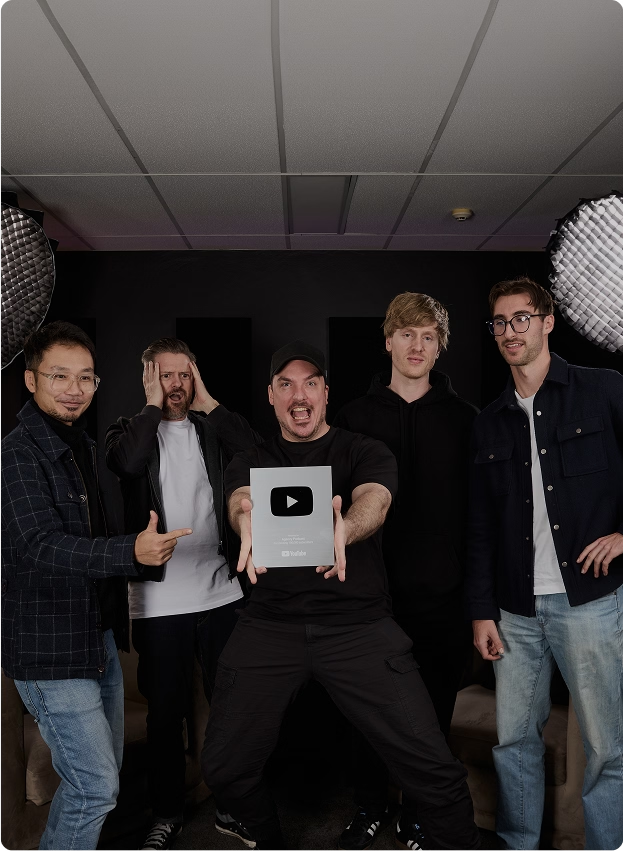

Stream now
Dive into expert advice and industry trends.