

TLDR
Summary
Jonathan Byrt, co-founder of memobottle, discusses the brand's journey from a viral Kickstarter launch to navigating significant financial challenges, particularly during the 2020 pandemic. He shares how memobottle overcame near-total revenue loss by embracing a marketing-led approach, focusing on creative hustling, and launching a highly successful stainless steel bottle campaign that pulled the company out of massive debt. Byrt details the development of a Four Channel Growth Model (e-commerce, B2B, Amazon, co-branding) and emphasizes the critical importance of a founder knowing their business's financial numbers, optimizing the supply chain for cash flow, and implementing a "founder first delegation" principle to ensure effective scaling and integrity.
Highlights
- Impact and Debt: Memobottle has helped prevent the consumption of over 300 million single-use bottles, but the business faced financial distress, accumulating an estimated $400,000 to $600,000 in debt at one point.
- Viral Launch: The initial 2014 Kickstarter campaign exceeded all expectations, selling 14,000 bottles (originally projected at 500) and generating $300,000 in sales.
- Pandemic Crisis: The 2020 global lockdowns caused 80% of memobottle's revenue to dry up in one week due to the heavy reliance on retail stores, forcing the company to consider laying off its entire six-person team before JobKeeper provided temporary relief.
- The Stainless Steel Campaign: A subsequent, intensely focused Kickstarter campaign for a stainless steel bottle range generated $1 million in pre-orders in 30 days, saving the business from its financial hole and creating new external demand.
- B2B "Leaky Bucket": Memobottle was initially excellent at onboarding new B2B customers (acquiring hundreds of stores at trade shows) but had minimal retention due to a lack of focus on in-store education, displays, and relationship management.
- Four Channel Growth Model: The business pivoted to focus on four distinct and scalable revenue streams: B2B (through distributors), E-commerce, Amazon, and Co-branding (corporate partnerships).
- Financial Metrics: Byrt stresses the need for e-commerce brands to understand their numbers, including the Marketing Efficiency Ratio (MER), which for memobottle sits between 30% and 35%. He also advocates for an absolute minimum product cost-to-retail-price ratio of five times (ideally seven to eight times) to ensure profitability across multiple distribution layers.
- Co-Branding Success: The co-branding channel, secured by optimizing supply chain terms to allow stock holding and rapid fulfillment, now accounts for 30% of memobottle's revenue, with partners including Bentley, Spotify, and Meta.
- Delegation Golden Rule: The principle of "create it yourself, test it, then delegate" was adopted after early outsourcing failures, ensuring that founders first understand and document a role before offloading it to an agency or new hire.
- Strategic Time Blocking: The founders schedule 4-5 hours every Thursday for strategy and "deep work," recognizing that this is the first activity to be cut when busy but the most crucial for long-term growth.
Transcript
00:00:01 - 00:01:18
You've helped prevent [music] the consumption of over 300 million single-use bottles. However, [music] it wasn't always smooth sailing. [laughter] I'd be guessing we probably would have had four $4 to $600,000 of debt. We went to work and created this insanely good Kickstarter campaign for Stainless Steel and it did a million in pre-orders and revolutionized the [music] business. We did things to try to grow the business and create brand exposure that were a little bit unconventional.
00:00:41 - 00:01:38
We've known each other since we were 3 or 4 years old, [music] so we work extremely well with our backs against the wall. had no money coming in the door. So, we came to the decision that [music] we're going to have to let go of my entire team. The only regrets I have in life are things that I didn't do. I mean, it's easy to say now at almost 40 with a family and a mortgage, but like at 27, I don't think it's really ever taken a leap, is it? It's just just try things.
00:01:09 - 00:02:11
A constant conversation for [music] us is how do we maintain this really designled brand but scale commercially? Where do people go wrong in these negotiations and how can they better position themselves to have a better chance of success? I think I think most founders go wrong by this episode is brought to you by Wix Studio. Here at the agency podcast, we're building a community and we would love for you guys to be part of it. So, we would love to hear from you. What are you enjoying the most? What would you
00:01:46 - 00:02:42
like to see more of and what do you think might be missing? Drop a comment. Make sure you subscribe. And now on with the show. >> Jonathan, welcome to the Agency podcast. >> Good to be here, man. >> Take me into that because Memo Bottle at one point in time was just absolutely meteoric. You guys were everywhere. I remember seeing the ads. I remember seeing you in the press. I remember seeing articles about it. You had partnerships humming. You were, you know, a design-led brand winning awards.
00:02:13 - 00:03:17
How did it feel to be at the helm of Memo Bottle? >> We started with a Kickstarter campaign 2014 and we had no expectations going into that whatsoever and it just it blew up sort of overnight and went viral. We did I think we we thought that we might be able to do 500 bottles potentially and we end up selling 14,000 or something 300 grand in sales and calls from the Oscars including the Oscars gift bags. It was just this crazy crazy adventure. It launched us into this crazy life um where we're traveling all
00:02:45 - 00:03:42
over the world and we're stocked in amazing stores, Urban Outfitters and things like that and it's just like all this stuff that you don't even dream of really when you just start thinking of a concept. >> What were you most proud of up to that point in the business? One of the things that was what we found most amazing was we're having conversations with our customers which was really rare at the at the time like just being able to get real time feedback around how your products were changing their lives and
00:03:13 - 00:03:51
you know these are water bottles you don't really think that you're changing people's lives when you're creating a water bottle but I guess the design of it allowed people to carry water more and we were hearing that you know it was changing their lives and just starting to see like the impact on people's lives personally when you're having those conversations was was pretty awesome. >> And then from the business perspective, obviously coming into this and thinking
00:03:32 - 00:04:24
about, you know, this is a side hustle together with my friend that I grew up with and went to school with and I understand that like he's very designled and you're very kind of like numbers and um you know, strategically led and here you guys are teaming up on this thing and then before you know it, it's going absolutely viral. Yeah. Um, was there anything else in the business that really sparked something in you that you felt like, whoa, I wasn't expecting to be living a life like this? Like what
00:03:58 - 00:04:55
was a moment of pride where you're like, "Holy crap, like we've built something pretty significant." Pre-memo, I was working at a financial consultant in Boston. We got put on a a job at a stock exchange listed business that was based out of Cleveland. Um because what had happened is the finance team and all went in on a Powerball ticket and there was about 20 in the finance team and the [ __ ] Powerball ticket got up and they all just quit their job the next day. Yeah. >> You weren't in the
00:04:27 - 00:05:23
>> We so we so we had to go in as a consultancy and try to steer the ship on this on this business. Had no [ __ ] idea what we were doing. We worked every single day, weekends included, for 6 months, like 100 plus hour weeks. And like that's at the same time when we launched. So Jesse and I were working on memo Kickstarter campaign in the background. So it was almost like when this Kickstarter campaign went live, it went viral. I quit my job pretty much the next day or very soon after. And it
00:04:55 - 00:05:53
just launched us into this lifestyle that we'd sort of dreamed of. and and setting up this setting up Memo Bottle from then on was almost like a break away from the corporate shackles and and run a business the way we want it to be run with adventure and excitement and impact and and um you know design led I feel like we were really making a bit of a difference. So I think that was that was the personal love and drive for us at the time. Not so much how big can we build this thing >> at its absolute height like at that
00:05:24 - 00:06:19
point in time like take us into in your mind like what were you experiencing? What were you thinking? What were you feeling >> uh at this height before um the global pandemic? >> Um we came back to Melbourne and we had made the decision that it's time to just knuckle down and and start to push. We actually did a small investment raise to go out and do a big trade show tour and just bring on a heap of distributors and retail stores and things like that. Um yeah, so again I guess this this is when
00:05:52 - 00:06:34
it sort of started to peak and we [snorts] went off did a tour around the world of international trade shows. Absolutely killed it. So went to New York, Paris, Frankfurt, all these amazing trade shows, on boarded hundreds and hundreds of retail stores. And the nature of the trade shows is you're taking orders but you're not collecting cash. So you're going you're taking them on a piece of paper. you're not taking cash or fulfilling them just yet until you get home and sort it all out at the
00:06:13 - 00:07:02
office. But we got back to Australia and one by one all this every single order was canceled. Must have been a period of maybe one week. Um 80% of our revenue just dried up. All of our retail stores closed. Lockdowns were kicked in. So >> in one week. >> Yeah. >> So at that point in time, the business was heavily retail. >> Heavy. Heavily. >> Okay. So then what percentage of your business at that time was retailentric? >> We weren't even doing paid ads back
00:06:37 - 00:07:37
then, 2020. We we ran for five years without four or five years without doing paid ads. >> Wow. Yeah. >> Okay. So you were So it was all organic. >> Hype organic in retail. The whole world closes like that and then 80% of your revenue gone. >> Gone. >> Yep. We had no idea how to how we're going to bounce out of that because we had no real exposure to what the business looked looked like outside of what we've been doing for 5 years. We had no money coming in the door. Two
00:07:07 - 00:08:26
weeks later after we got back home, we went for a walk along the beach down in Melbourne and um we came to the decision that tomorrow we're going to have to let go of our entire team. And at that point wasn't huge, but maybe six six staff. And we woke up the next morning and JobKeeper came in which just like kept the lights on in the business, gave us a little bit of breathing room to try to work out how we get ourselves out of this [ __ ] And um yeah, it it just le it just led to a complete
00:07:46 - 00:08:58
breakdown and recreation of the way that we run the business. We just rolled up our sleeves and just got creative and and hustled [clears throat] and pulled in free media that, you know, other brands weren't doing and just like little little concepts that kept the money coming in just enough to stay alive. And then um we worked on a big plan to get us out of there, which was the big stainless steel water bottle launch. And that um that pulled us out of there >> eventually which was wild. Yeah.
00:08:23 - 00:09:06
>> You had a relatively stable business that was scaling and paying overheads and all the rest of it. >> What were you blind to at that moment? >> Our product is very aesthetic. So it turned heads. We were very good at onboarding new customers acquisition like and we're mainly referring to B2B here because that's what we're doing predominantly. Extremely good at onboarding except then we had no retention. We just onboarded stores and just assumed they were just going to
00:08:44 - 00:09:33
keep reordering. We didn't. And like so many lessons have been learned here in our new the new way we run Memo Bottle. But no focus on instore displays, no focus on education, how the store clerks are going to be selling, no, you know, there's no none of that kind of stuff. It was just like place an order and then assume that we're off. Get out there and sell [laughter] it. >> Yeah. So that was one. There there are so many things that we're blind to at the time. cash flow, stock forecasting,
00:09:08 - 00:09:55
stock levels, and and how that impacts your business from a cash flow point of view, hiring, and just bringing someone on and hoping and assuming that they're just going to work out the role before you actually work out what the role is and create. I mean, there's so many things, man. It's there's been a lot of lessons over the years >> during all of this happening. >> You guys were scrambling for cash from how I understand it. And in these predicaments in a business where you're
00:09:33 - 00:10:25
kind of scrambling, you got to get thrifty. You got to find a way like how do we pay the bills like we got six people we got to pay, we got investors, we got to keep happy. Um you can't just turn the 80% back on. Totally. >> So what what was the strategy and how did you guys start to get traction and pivot um to get out of this predicament? >> We realized that we needed to start creating creating sort of brand exposure that was relatively cheap. There was a couple of things we did. Australian Open
00:09:58 - 00:10:44
was one. Um, the Australian Open have retail presences. We decided to invest in one of them. So, it was it was 10 grand for a two-eek period at the Australian Open. We went in there and just decked it out with competition walls. It was right next to the training court um for all of the players. And we're also selling product there. So, we we started to generate a bit of cash through that, but everyone coming in the gates wanted to play our activity to, you know, guess the number of balls on
00:10:21 - 00:11:06
the wall or whatever it was. But the practice courts were next door that had the Raphael Nadals and everyone practicing and they walked past our store to get back to their rooms or to the main stadium and we would grab them, take photos of them with the bottle and then put that on social media and you know the perceptions of reality that you're get over here bottle. >> So I mean we did we did lots of things like that. We were scrambling. We launched a sanitizer like a lot of brands did at the time. But the the
00:10:44 - 00:11:54
bigger thing was we had to do a bit of soularching to work out >> what it actually was that we're good at. um because what we were doing wasn't working. We realized that we were very good at storytelling, marketing, branding, product design. So, we really leaned into that. We started to put more and more resources into our marketing team. Um and then ultimately sort of redesigned the business to be more of a marketing product business. So that and then we created a few distinct sales channels from different
00:11:18 - 00:12:14
areas of demand that we saw coming into the business that um we weren't really capturing at that time. Um so the marketing ch the marketing team really just started to harness the demand and and push content out to each of those channels. Do you think that, you know, obviously getting in front of people, getting face to face, having a setup, a kiosk, like was that a pivotal moment where you started to realize a few things around how you would adapt the business for the future? >> I think it was that that sort of
00:11:46 - 00:12:41
>> got us going on the ecom front because there was a lot of there was a lot of content being created. there was a lot of information about our brand being shared online, but we weren't equipped coming into that period of time to capture that. So, we'd sort of identified that that we were a leaking bucket at that point. So, we were starting to create the brand exposure, but we weren't capturing it necessarily through ecom sales. So, that's when we started to lean a lot more into that. And um I guess that you
00:12:14 - 00:13:10
can say that that was probably the turning point for us to really develop as more of an ecom brand. >> 100%. And you've made mention that B2B is kind of >> quote unquote a leaky bucket >> when it comes to scaling a product base on brands. >> What do you mean by B2B being a leaky bucket? I think about this leaky bucket analogy a lot when we >> look at our current business to try to work out how we can scale, but also what the bottlenecks are and what's preventing us from scale and where we're
00:12:41 - 00:13:27
where the slippage is. On the B2B side, I think like I said, we're really good at on boarding. We're bringing on hundreds to thousands of stores at these trade shows, but then we were just on boarding them and giving them nothing. They would they would place their order, receive the stock, not not know how to set it up, not know how to like pitch it to their customers because there's multiple layers. >> You might be like, how do I put this on a shelf? Like, do I stack them like
00:13:05 - 00:14:00
this? [laughter] Yeah. Yeah. >> You need some kind of instruction, I guess. Yeah. >> Yeah. There's so many variables that come into a B2B sale from education and training of the team, um, promotional materials, the packaging of the product. So, ours back in the day was in an enclosed box and then they go into stores and it' just be an enclosed flat box and no one knew what it was. So, like how you going to sell a water bottle when it's just completely covered? Um, so we were a complete leaky
00:13:32 - 00:14:25
bucket because we're onboarding and then had very minimal effort and systems and processes going into how we're going to retain all these stores. So ultimately the sell through rates were just horrible. We were just onboarding stores and paying all these acquisition costs for them to not reorder again. >> What was the moment where you realized this? Yeah, I I think again it was coming into that pandemic period where we were relying on we weren't able to do acquisition anymore because the trade
00:13:58 - 00:14:52
shows and the lockdowns. So we were relying on existing customers that just didn't know how to resell. So they weren't placing reorders. So there was a lot of soulsearching happening around that period. Few issues we identified were that we had a very small team. We had 2,000 retail stores. just when you work out how much time would be required to even you know manage those relationships like we weren't equipped for it for starters. We didn't have a marketing team set up or the content or the resources and we had
00:14:25 - 00:15:25
nothing really flowing to the stores to allow them to to sell properly. We were selling to 50 countries like we didn't know who we're selling to. We didn't know who the end customer was and how to talk to them. So what we realized again going back to this marketing led approach was that we needed to create and empower our stores to sell. But to take it a step further back than that, we decided that we needed to onboard distributors and um sales agents in each of these regions to actually do it for us. And we're
00:14:56 - 00:15:48
empowering them. And then we're managing fewer relationships but making them really bang- on relationships [clears throat] and then rely on them to do the endm communications and relationships with their stores that they know they know the pricing they know the customs of the region. Um they know what what the cut through requirements are in terms of marketing that kind of stuff. So that's how we manage it now. It's it's marketing led to big distributor partners generally where we can um
00:15:21 - 00:16:12
empower them to do what they're best at. And if you were to identify like for anyone else who's considering trying to get into retail, [clears throat] trying to find B2B partners in in this case, what are some of the things that they're thinking about that get overlooked by a lot of other brands that those listening to this could capitalize on >> for us and most brands? Uh how is how's your products presented in store? So in in store displays, what does it look like? How is it standing out? What does
00:15:47 - 00:16:46
your packaging look like? Is it capturing attention? Does it does it allow for you to understand what the product does and how it can make you feel? Like, you know, does it create that emotional connection? Is everything that you're putting across in your marketing and your collateral both in stores and providing to stores and distributors for EDMs and things like that? Is that consistent to how you would be doing it as a brand yourself talking to your customer? It's basically consistency to make sure that like you
00:16:16 - 00:17:05
are the way that you would talk to your end customer if you were if you were at a design market or whatever it might be or an ecom brand. How can you translate that and empower your partner or your retail store to say that exact message? And it's really difficult when it becomes diluted when there's multiple layers that you're trying to sell through. >> What are those common mistakes that ecom owners are making when they're trying to go into retail? >> You don't know what you don't know
00:16:41 - 00:17:26
basically. So we would have conversations. We'd go into our stores and have direct conversations with them about how are the products going like what would you recommend? What sort of customers buying them? What's the feedback? That kind of thing. When we talked about distributors, it might be pricing discussions. Are you overpriced in the region? Do you reconsider your pricing strategy in certain regions rather than others? It could be operations and your products might be arriving damaged and you got no idea
00:17:04 - 00:17:51
until you get that feedback. So it's it's definitely having the conversations. So much of it as well is just talking to other brands or we we didn't do that when we were young. Like we I don't know what it what it is, but I think like we would have saved so much pain and time if we just went and asked people for help. >> I think that's a big one, right? It's a massive one. >> It's a big one because I I'll be on calls on occasion. Like I don't do a lot
00:17:27 - 00:18:14
of the onboarding like I used to for the agency. So >> for those listening, we have a branding agency with about 40 people and I used to take a lot of the calls myself. And you would have someone who's like kind of early days in ecom and you try to give them any feedback from any alternative perspective and it is a little prickly because they're like, "Man, I've spent six months to get to this point. Built my website. I built my brand. I've done the packaging. I don't
00:17:51 - 00:18:39
want any feedback. I know what I'm doing." Yeah. >> Like there's there is that resistance. What is that for people that you think makes them so broad >> to having outside opinion or to to bringing people in to support them? >> It's stupid, isn't it? If you've got the chance to sit down with someone that has done what you are wanting to do or is two years ahead of you or has spoken to a heap of people that have done what you're going to planning on doing, then
00:18:14 - 00:19:13
save yourself the pain. >> How early did you start to do all your own in-house marketing? >> We were outsourcing most of it coming into or preandemic when we were predominantly B2B business. um the learnings that we took from our pandemic failure. Um we realized that it had to be like we we needed we needed to be because we were inherently good at those sort of things. We needed to it needed to be coming from us. Um and it needed to be consistent across all of our channels and that was the only way that
00:18:44 - 00:19:49
we could do that and keep that consistency was to really build that in-house system. And if a business is at a point right now where they're let's say on a shoestring budget and they're trying to, you know, scale and get cash flow and adapt to the market. >> Um, is there a risk of trying to bring in-house marketing in too early? There's many ways you can do this. We brought on a part-timer offshore initially just to help with graphic design and that sort of got us started. um that went to
00:19:16 - 00:20:13
full-time, that went to two offshore employees, and we just sort of built it that way, I think, just from just from dipping your toes in the water a little bit to see what the impact is rather than taking a full commit on on a role. I'm right there with you. I think it's difficult to critique or provide feedback or lead a team that you're outsourcing it to if you're undereducated as to what exactly they're doing. And how would you know good or bad if you've never done it for
00:19:45 - 00:20:29
yourself? I've said this to people before which which is, you know, you can't conduct that which you cannot teach. So if you're uh a conductor of an orchestra, you don't know percussions or drumming. Like how can you know good or bad? >> How do you know how to tell them to tune? How do you know how to tell them to play to the right beat? So if you're outsourcing your marketing >> performatively to another company, >> what's the risk of that? And what's the
00:20:07 - 00:21:07
advantage of learning how to do it yourself? >> I think it's probably two things. I think it is communication gap. So if you're not briefing correctly to your marketing agency and you're not well communicating it as to what you want, it the message dilutes and I think the end result is probably not as good as what you would generated if did it inhouse if you had the right capability. >> And it takes time too because you have to provide feedback, wait for them to recreate the work, send it back to
00:20:37 - 00:21:31
youact back and >> forth. That's another one just pure speed. speed to market a lot quicker if you've got it in house and then feedback loop of performance as to whether that is actually working for you is a lot harder to test because you're probably getting a lot of that data internally. The advertising agency aren't getting that directly. A lot harder to patch together the performance. Clients want it all. A slick looking website that can run their business and scale with their
00:21:03 - 00:22:17
success. Wix Studio [music] is built for that. Plan out your client's whole site in seconds with AI powered [music] site mapping and wireframing. Then, when everyone's on the same page, jump into the creative, starting off in Figma or in the Wix Studio editor with super precise layouting tools like grid, stack, and flexbox. [music] Go above and beyond the brief with no code animations, custom CSS, and built-in business solutions. and make your whole vision responsive in a click. And there's zero need to break a sweat when
00:21:39 - 00:22:53
clients grow fast. A dynamic CMS with global design settings and reusable assets lets you turn one page into hundreds. Design smoother and deliver sooner. Go to wixstudio.com. >> All right. So, through all of this adversity, you have established the 4 channel growth model. >> Yeah. What is that? >> There were four distinct ones being B2B, ecom, Amazon, co-branding. Now, we saw pretty pretty decent demand coming from from all of those potential avenues. I guess we'll just unpack each of them, but um
00:22:18 - 00:23:21
the B2B one is a pretty obvious one. That's where we started. Ecom was something that we had doubled with, but never really gone hard. We'd never done paid ads like we spoke about. So, we really doubled into that. Double down into that. Amazon was kind of an additional one to ecom, but um quick story behind that one. We had a a reseller that we were selling to that was based in the US and they were one of those Amazon resellers and they started to the POS just started to come through a little bit more um a little bit faster
00:22:49 - 00:23:42
and we realized that there was potential there um for our products and turns out that it is being a very gifty item. It's a it's quite a good Amazon product. there's a certain product that does very well on Amazon and and we we were that so we lent into that and brought that in-house and then the final one was corporate. So if you see our products it's a flat flat blank canvas. We had a lot of demand coming in from corporate companies wanting to put their logos on the bottles. So um we dabbled with that
00:23:16 - 00:24:06
a little bit realized that it was a viable model for us and then we really sort of built that out and scaled it. >> Okay. So there's kind of like I in my mind I'm such a visual guy I'm kind of seeing like these four playbooks. Y >> and the first playbook is kind of everything e-commerce >> and at a certain point in time you didn't have meta ads everything was organic and you're like [ __ ] we need to come up with like a go to market strategy how do we maximize ecom the
00:23:41 - 00:24:38
second one being B2B so this is where you started to work directly with the distributors the stores um and how we can I guess pivot without alien alienating them and giving them as good of a layup as possible to sell more stuff which is good for them and good for you Amazon which I'm excited to go into. And the the fourth one which is interesting which is how do we co-create or co-brand together with cool companies. >> Let's come back to that. Let's open this up with ecom. Um on the ecom side, your
00:24:09 - 00:25:10
first attempt in scaling paid ads left you guys in debt. Like [laughter] what happened, dude? And and then how did you solve the ecom strategy? >> It brings back trauma just thinking about it. I mean, so >> let's imagine we're opening that book and it's like these are the things you should not do. Like what are those things? >> So many lessons were learned. Um, >> we had no ads experience. We onboarded an agency to run ads for us. Um, >> you tried to outsource it. You like
00:24:40 - 00:25:31
>> Yeah. Yeah. We tried to outsource. We We made the mistake of not really understanding the process ourselves, which again, like lesson learned now. Um, we went and got ourselves a nice AX Platinum just to [laughter] just to double down on ads. >> It's always dangerous. >> We didn't have the creative velocity set up at that time. So, um, marketing team wasn't really built out. We didn't have enough content to be able to justify it. We didn't have operations, cash flow,
00:25:05 - 00:26:03
stock levels set up. So, it was just a bit of a perfect storm of scaling up. Again, the leaky bucket analogy. We had way too many leaks. And as soon as we started to scale, um, things didn't go well for us. And we had I'm an accountant, so I'm sort of ashamed to not to to say this, but like >> I didn't understand the ecom scale mentality and numbers. What do you mean by that? Like what is that? Let's imagine those listening to this also have no idea. >> Yeah. >> Let's say someone's like, "Man, I want
00:25:34 - 00:26:27
to start an ecom business. I've got an idea. I'm about to get it off the ground." What were those things that you didn't know about that they should know about and they should start to think about? I guess at its basic form it is just understanding getting clarity of your business where you're currently at and being real about that and then understanding your numbers man like and we we're with e-commerce equation now Jay Wright absolutely legend but like one of the things that he preaches
00:26:00 - 00:27:04
initially when you come into the come into the community is get solid on what your numbers are and your margins and break it down into into buckets of direct cost and your cogs and then your marketing spend and your variable costs and then your fixed costs and really understanding what they look like, what fits into those buckets, what percentages they are, and ultimately like how much is left as a margin. And there's there's only so many levers that you can pull in that equation that can
00:26:32 - 00:27:38
create scale. What we learned the hard way is we didn't have a solid understanding of what those buckets exactly look like in the ecom world. Um, we went too hard too quickly on ads. We got into a lot of working capital debt. Um, and we didn't have any other ecom was having to fund all of our overheads. We didn't have any other business any revenue channels to um, pick up the slack. So, >> yeah. So, you're all your eggs are kind of in one basket, right? >> It's really in the ecom basket.
00:27:06 - 00:28:03
[laughter] Yeah. Yeah. So, were you guys just sending it on the AX? Like, we'll set up the ads, put 50 grand on for the month, go. Like, you weren't really >> Yeah. Well, I mean, it was it was a little bit more calculated than that, but like in hindsight. >> Yeah. [laughter] >> Pretty much. Um, and it all came crashing down again. So, just another another trip around the around the hero's journey. Um, yeah, I I I went through all the numbers and sort of worked out that we had about a 13week
00:27:34 - 00:28:20
runway left. [ __ ] >> Yeah. >> 13 weeks. >> 13 weeks. >> Ran out of money. >> Completely ran out of money. So, this is this is coming into mid 2021. >> Jesse has just shot off on his honeymoon. He's just got married. Six week honeymoon. That was the deal when we started the business. We both get six week honeymoon. So, he's off. [laughter] Um things were great. We thought it was great cuz the money was coming in. We we didn't realize that um there was
00:27:57 - 00:29:11
[clears throat] a big big leaky bucket there. Um, and yeah, we I realized that we 13We runway, we were pretty doomed and we needed something very big to get us out of it. Like general operations wasn't going to work the way we're currently running again um via this single model. Um tried to I tried to internalize it as much as possible and not put it onto the team and and Jesse. Um but ultimately the runway got shorter and shorter and I had to give Jesse a call on his honeymoon. and um let him know that he better enjoy
00:28:34 - 00:29:31
that margarita cuz when he [laughter] when he comes back there might not be a business waiting for him which was which was bloody hard. I laugh about it now. Um but it was it was brutal. >> So you went from a 13we run rate >> down to what >> uh nine or 10 weeks before I made the call to Jesse and >> just seeing it shrink. >> Yeah. Just Yeah. Exactly. And then you're like, I got to >> call. Outflows were going out at a more rapid rate than inflows for cash. And
00:29:02 - 00:30:11
we're in a real and and this is the issue as well when you get when you are fully reliant on ecom and you know what you've got a certain level of fixed costs and overheads to to hit each each month and you can find yourself in this really tricky middle ground of either a you pull back on ads and just rely more more on organic but lower revenues and you may not be able to cover from that profit all of your overheads. or B, you send it on ads and hope that your fixed cost as a percentage of your
00:29:36 - 00:30:23
overall revenue starts to decrease and therefore you're more profitable as you scale. >> Okay. >> Um, we were stuck in that middle ground and it was really tricky because we didn't have any other revenue channels to support it. If we pulled back on ad spend, our overall revenue was going down, our overall profit was going down and we wouldn't have been able to. >> You're stuck in this tricky spot where you're like kind of screwed every which way. >> Yeah. other than the situation you're
00:30:00 - 00:30:46
in, which also sucks [laughter] >> 100%. And >> and you can't really get out of that. You can't you can't just send it on ads unless you have >> the leaky bucket fixed >> or an AX. >> Well, the AMX just [laughter] the AX just intensifies all of that. But yeah, like we we didn't have we weren't set up operationally. We weren't set up like creatively. So we we dwelled on it for short period of time and then it's just roll up the sleeves and solutions
00:30:23 - 00:31:13
focused like how do we we don't have a choice like let's just focus on what we can control here. Um we had been working on a concept and Jesse and the and the design team had been working on our stainless steel range for quite a while. It was nowhere near there but we had at that time it was just our our plastic our Triton bottles. >> Right. So if you want to hold this up for the viewers right now. This is the plastic version of your product. >> This is the Triton bottle. Yeah. It's
00:30:47 - 00:31:38
got the silicon sleeve on it. Um, just remember like at this point we were seven I guess years old as a as a business. We've been rocking the same product for seven years and >> there's not a lot of innovation in seven years. >> No, not really. Not really. >> The market kind of >> collapses and it was like a >> so what what's new? What are we talking about? You know, so >> and at the same time we'd had a lot of >> there was an undercurrent away from
00:31:13 - 00:32:04
plastics like an obvious one. and there was a certain type of customer that would purchase this and there was a certain type of customer that wouldn't touch it and wanted stainless steel. So, we're getting a lot of that feedback directly in our in our marketing, our social media. So, we knew that the demand was there. So, anyway, we we had been we had been working on a stainless steel bottle. Um, as I said, nowhere near it, but Jesse came back from his honeymoon. We looked at the runway and
00:31:38 - 00:33:07
realized that we had six weeks to create a Kickstarter campaign and do something massive to pull us out of this hole. Um, can't remember the exact numbers, but I'd be guessing we probably would have had 6 to 800, yeah, four to $600,000 of debt probably. Um, with not really any clear way of how to pay it back. Um, we went to work and created this insanely good Kickstarter campaign for Stainless Steel in the space of 6 weeks. Launched it and it did a million in pre-orders in 30 days and revolutionized and just revamped the
00:32:23 - 00:33:26
business. Like, not only did it get us out of this cash hole, it it revolutionized the business. It created a heap of external demand. Um, and it gave us a heap of breathing room to again sit back, restrategize, and realize where we're going wrong and what needed to be done both as as founders and and and people um and the business. >> Do you think that that campaign saved the business? >> 100%. >> Did you realize the gravity of that campaign at that time? >> Yeah, I cried as soon as we launched it.
00:32:54 - 00:33:56
I was very emotional when Jesse was on his honeymoon just before I think it was actually the same week that I called him. So I was like I was the most stressed I'd ever been. But that same week Gemma and I realized that we were pregnant with our first child. The whole timing of kids and that period of time at Mail Bottle as well perspective time allocation priority allocation like something just clicked. And so yes, that campaign definitely saved Melbottle, but there was a few things that happened at
00:33:25 - 00:34:22
that same time that completely changed our mentality in the way that we operate and the way that we view things at the business from a priority like 8020 point of view that was incredible. >> Like what was happening in your mind at this time? Like what was that shift for you to go, okay, like nothing's really quite working right now. We got to change some [ __ ] Like where were you in your head? That campaign obviously got us out of a financial hole, but it it it sent us viral again. There was a lot of
00:33:54 - 00:34:53
publications written about us. And remember at this time we like we weren't doing a huge amount of acquisition. Like yes, we've been spending a bit on ads, but we weren't doing any PR or anything. So it brought in a huge amount of inbound demand for the business. Um, and again back to that leaky bucket analogy, it's we sort of we had a bit more breathing room to sit back and think, okay, like if we would have unlimited demand or water flowing into this bucket, like what what are the
00:34:24 - 00:35:27
non-negotiables that we need to be able to capture it and then we really just sat back and did the whole Pareto principle 8020 on what we need to be focusing on to really move the needle. And that's when the the four four revenue business model thing all started to come together for us. We realized that a we needed to be really really solidify this marketing approach of our business. So it was consistent communication and brand messaging across across all channels and then really try to start
00:34:55 - 00:35:46
identifying drivers of each of these channels and only work on what's important. And so I think just to tie back what you're saying like having a kid, you don't have time to [ __ ] around anymore, you know? Like you don't you don't have time to just sit there and work on the stu I was going to say stupid [ __ ] but all the little stuff that in hindsight like I spent so much time just working on things that weren't all that important into the business. And having a kid just makes
00:35:21 - 00:36:07
you sit back and go, I've got x amount of time now. I'm only going to work on like what what are the absolute mustd dos right now? And it's really focusing on those things and just cutting out all the noise >> when you are looking at as a broad stroke when you're like, "Okay, how do we dominate ecom?" Yeah. >> Get your numbers right, track that ruthlessly, make sure your ads are tight and they're working. Is there anything else we need to be putting in our
00:35:45 - 00:36:41
playbook? >> We created what we call a content matrix. So for all the things that we want to be talking about, we try to hit it from different angles, whether it be founder, UGC, more graphic design, lowfi, like we're trying to communicate our USPs in in different ways. So that was a big one for us. We just didn't have the creative output coming into it. Um so really doubling down on the marketing team and nailing that. Numbers, obviously, um we got really really deep on the numbers.
00:36:12 - 00:36:57
Operationally, we were over capitalizing in low demand products like accessories and things like that. And we would go to production. We've got relatively high minimums for all of our products. So, you know, silicon sleeve might be 5,000 units or something. And we would just go to production on that because it looked like we're going to be selling out at some point in time, but that would come at the extent of us being able to buy more bottles in two months time. And we would just see stock outages across
00:36:35 - 00:37:17
various warehouses. >> Okay. So, >> is this um so Jay talked about this a little bit just just so I can understand this. You're saying like for example rather than like having a year's worth of product on the shelf. >> Yeah. >> Have like three months and then have >> six weeks even. >> Six weeks. So like have a minimum coverage. Coverage is making sure you have enough product to fulfill orders but not so much so that it just sits there as like wasted money
00:36:56 - 00:37:37
>> because you'd rather free that capital up and then spend that money on ads and things like that. >> I think a lot of founders think as long as we got enough stock we're sweet but they don't understand the cash flow implications of being overstocked >> because you need stock and cash flow and marketing capability. >> Yeah. Yeah. >> So, so our producer Cam here used to work at G-Shock and he said that one of the rules of G-Shock, which was for every dollar uh that goes towards
00:37:16 - 00:38:05
production, you should have $2 to amplify it. >> Yeah. >> Right. So, you can't just have, you know, uh a warehouse full of watches. We got to move this stuff. >> Yeah. >> So, G-Shock's rule was we need to spend twice as much on amplifying and promoting a product as we do producing it, putting it in the warehouse. >> Yeah. I like that. >> It's cool, right? >> It is cool. So, so with ecom like what did you misunderstand about the metrics at that time and what do you know now
00:37:41 - 00:38:38
that you're like okay cool like you got to make sure you have these three or four or five things squared away. Um on the financial side the metrics were that we we weren't really sure about like again there's a sliding scale of scale and um the marketing efficiency ratio the me like we we didn't really understand that. So that is the percentage of your marketing advertising spend against revenue. >> Okay, cool. So let's say we make a million bucks revenue. How much of that
00:38:10 - 00:38:58
are we willing to put back into marketing? >> Correct. 350K going towards marketing. So >> 35%. >> Yeah. >> Is that too high or is that like >> probably too high? I think like [laughter] >> I've heard different >> Yeah. I mean depends on the industry, depends on your business. Like for us, we sit between that 30 35%. Um it is pretty high. Yeah. I think like in the e e-commerce equation community, I think you're probably going to see like somewhere between sort of 15 up to 3540.
00:38:34 - 00:39:27
>> Yeah. >> Um, again, depends on your business, but a lot of businesses as well don't really understand like what are the requirements in their price setting as well. >> If you were to be selling a product for 20 bucks with a cost of 10, so that's your COGS, you're then going to have to have your variable costs, which are your shipping cost to your customer, your pick fees, warehousing, stuff like that. For us, that sort of sits around that 30% mark. You got your me, your
00:39:00 - 00:39:49
marketing, advertising costs, which again somewhere between 15 and 35%. Then you've got all your overheads, your fixed costs, depending on your business, that could be somewhere between 10 and 20%. So you're already look like there's that's a lot of the pie already gone. And like if you just work off those numbers, if you're selling for 20 bucks, you're probably already sitting at a loss of what what I don't know the math there. What's that? 12 11 12 bucks or something like that. So we have a rule
00:39:24 - 00:40:10
of thumb thumb that is absolute minimum five times cost >> and >> okay so absolute minimum >> absolute minimum five >> five times cost >> so let's say a >> and that's that's pretty that's slim >> okay so let's just say cost is like 10 bucks you want to sell it for 50 yeah >> that's like >> that's the minimum >> that's the minimum >> this is an interesting point >> and I've spoken to uh quite a few people
00:39:48 - 00:40:58
in the e-com space recently yeah >> and it seems like there's these kind of like different like myths around numbers. Why is the five times such an important concept and and why is that an unlock or why is that being such an unlock for you guys? So the five times minimum the whole notion behind that is when you're selling in B2B there's multiple levels of sale and margin requirements. There's multiple people that are taking a cut of the pie. So in our case we end customer purchases at our RRP
00:40:23 - 00:41:21
they buy it off a store which require 50% of the RP as their margin that already takes off half in our case we work with distributors so the stores will buy it off distributors and the distributors will require somewhere between 30 or 40% as well and then it's our sale price to the distributors and our cogs. So like when you work it back, you kind of need a five times cost just to be able to be profiting from a >> Oh, I see. Cuz like you've got all these layers, right? So So take me in reverse
00:40:52 - 00:41:43
and let's use a figurative number. Let's say I have a Beach Tail Y brand. >> Cool. Beach brand, 100 bucks retail price, right? That's what you set it as. >> If I'm going into a store, it's 100 bucks. >> Yep. In the store, it's 100 bucks. Um, and if we're working off the five times model, the cost to you from your manufacturing supplier is 20 bucks. You're going to sell it to a distributor if you are working with distributors, which we are for our global
00:41:18 - 00:42:20
distribution. And they need to sell it to a retail store and the retail store is buying it off the is buying it for half of the RP. So the retail store is buying it for 50 bucks. So the distributor needs to be making about 30 to 40% from that 50, right? So that takes it down to about 30 bucks roughly, give or take. >> 35 there about. Yeah. >> Yeah. And then your cost is 20 bucks. So you're like you've got a $100 product and you're taking 10 to 15 bucks profit >> and that is before you factor in your
00:41:49 - 00:42:45
overheads, all your other business costs. So it's it's slim when you work it down across all those levels. So that's why for us we work off an absolute minimum five but generally aiming for seven to eight cost. >> Seven to eight is ideal. How can then ecom business owners give themselves a better opportunity at this and you're saying that it's 7 to eight times? >> Yeah. >> So then it's like maybe it costs 10 bucks to manufacture and at least 80 at retail.
00:42:17 - 00:43:10
>> To be honest, when you're running the marketing expenses that are required for ecom, it turns out it's a pretty similar margin at the end of the day. that sort of 10 to 15%. Um, but ultimately the more margin that you have, the more times cost you have, the more room you've got to put into marketing and the distribution of your product so that people can hear about it. So, >> so like are business owners that try to go into retail and ecom, are they shooting themselves in the foot by not
00:42:43 - 00:43:42
forecasting or premeditating what these actual numbers should be? >> Yeah, absolutely. Yeah. Yeah. What's the most common thing you've seen that has held people back that that should just not happen when you're trying to launch an ecom? >> From a from a spend and margin point of view, I think it is exactly that. It is not giving yourself enough leg room. You might realize that in order to sell your products, you need to be spending at least 35% on meta ads to get conversion.
00:43:12 - 00:43:59
Um, now if you generally the more you scale, the higher your ME is going to go up. Like it's usually that's usually the way it is. Um I don't see many businesses that have a lower advertising cost as a percentage the more they scale. >> How does B2B differ from B2C? So like is is there a different tactic that you're trying to think about when you're going to market with this kind of strategy? >> Yeah, B2B acquisition is a completely different we don't we don't really do
00:43:36 - 00:44:36
paid ads at all for B2B. So generally it is trade shows which are arguably a bit of a dying breed now these days like with technology and AI and there's a lot of there's a lot of marketplaces that are popping up um at the extent of trade shows like fair is a big one globally that is basically like brands will sign up to that and then list all their products and retail stores will go to fair and try to identify products that they want and then start stocking through that website. Um but yeah, for
00:44:06 - 00:45:01
us it is historically been trade shows and then trying to identify distributors that are killing it in geos that we want to expand into that are stocking brands that we love and kind of think are comparable. >> Would you say, okay, let's take trade shows for example. [clears throat and cough] >> So on the weekend I went to like a baby expo trade show. So there was like man like every baby brand you've ever heard of, every breast milk pump, every like pram, like this this was mayhem. I'd
00:44:33 - 00:45:30
never seen so many pregnant women >> in my [laughter] life and I've never heard so many simultaneous crying children. Um, but I remember as I was going through these different expos like these brands were putting significant amount of money into like you know signage and displays and like spinning things like is showing up at trade shows really worth the investment for an e-commerce brand? >> I think that it's probably too much of an investment to make without validating the fact that you your products will
00:45:01 - 00:45:50
work in store. Okay. And what I mean by that is I think >> so skip the trade shows and try to find another strategy. >> I would skip the trade shows and go grassroots first. >> What do you mean by grassroots? >> So like the way the way we started was and yes we were with the Kickstarter campaign but we started into this B2B world because Jesse was backpacking around Europe and I was living in the States and we had a couple of bottles with us in our backpacks and we would
00:45:26 - 00:46:12
just go town to town. So Jesse was while he was backpacking, he'd just jump online and work out what the coolest stores were in the town that he was going to next and we just go in there and pitch to the store. And I think like there's so much value in that just being able to speak to the store owners, try to get in there first, see what the sulfur is like in those stores, get a couple going and then sort of just you need to validate it in small baby steps first. So that's what that's what we did
00:45:50 - 00:46:37
and we probably racked up a couple hundred stores before we started to even consider any trade shows and doing it at a larger scale. Do you know the brand Switch Nutrition? >> No. >> So, it's it's pretty significant. Like if you go into any supplement store in Australia like and you look anywhere, you'll find Switch Nutrition. >> Yeah. >> Uh but yeah, I'll give him a shout out. My friend Greg Hagglund, >> his whole strategy was grassroots from the beginning. And what he did was he
00:46:13 - 00:47:02
had like a couple of different supplements. One which was like a fat burner, another one which was like for keto, etc. He'd fill up his boot >> and he would literally drive from supplement shop to health shop to supplement shop to health shop. And he would walk into every single store, shake everyone's hand, grab their mobile phone details, leave them a handful of product that they could personally test. Yeah. >> And he drove around Australia multiple times. >> Yeah. >> With boots and trailers full of product.
00:46:37 - 00:47:29
>> And now it's arguably one of the fastest scaling supplement brands in Australia. But I want to touch on this because so many founders avoid these like old school tactics of like shaking hands, exchanging phone numbers, and like like doing >> old school business. >> Yeah. Cuz it's hard. It's character building. It gives you thick skin. It It teaches you how to learn and deal with reject. Um >> you have to learn how to sell your [ __ ] too. >> Yeah, you got to learn how to pitch. Um
00:47:03 - 00:47:54
so, we learned how to sell from doing that. That interaction with the customers allowed us to ultimately understand what our USPs were and why why people wanted to buy it and why um and how we market it to both stores and direct customers. Like these days as well with with AI, it's arguably more important. Like people want that emotional human connection, don't they? So, it's going to get more cut through than just sending out a bloody mass email. Like, >> yeah, I'm going to say something
00:47:29 - 00:48:08
controversial. >> Give it to me. >> A lot of people like to say, "I'm an entrepreneur." >> Yeah. >> But if you can't walk into a business and have a conversation with another business owner, I would debate you're not. >> Yeah. >> Like the these are the fundamental things that people need to get their head around because, >> you know, the younger generations want to do everything behind a keyboard and text messages and emails. And I get it.
00:47:48 - 00:48:25
I get it. It's like it's like rejection sucks. But like in those moments when you're you're thinking to yourself like, "Shit, this person's not buying my pitch." Then you're like clutching for like other things, but then you say something, it lands, then you get an order, then you're like, "Man, I could probably repeat that." >> It's like you're looking for these little like things that you can link together, these little unlocks, these
00:48:07 - 00:49:02
little lessons that you can start to stack. When when you're thinking about the B2B, is there any other strategies that you guys deployed? So grassroots emails, face to face, you know, basically door knockocking stores and saying, "Yep, >> put some of these bad boys on your shelf." Like what else? It's the relationship management. It is the initial training and education and samples and um instore display and um effective packaging for to sell in stores. Um and then the constant flow of
00:48:34 - 00:49:13
marketing material, promotional material. Um if you think about a store owner, what do they want? They want to sell products, have happy customers, and have people come back to their shop. If you're one of the few suppliers that like goes out of your way to see how they're doing, even if they're not moving a lot of your product, they might push a little harder to try. >> Yeah. They might they might put you in the window, you know, like there's there's a lot of things you can do just
00:48:54 - 00:49:54
from building a relationship. Um people want to work with people that they like generally like obviously like >> if you if the product's selling, then that helps, but if if you're going to form a relationship, you can you can call on a few extra things that might push the product a little bit harder. >> Okay. So then moving across to Amazon. >> Yeah. So, let's imagine we're now opening that survival book. Um, on Amazon, you first noticed that a reseller was scaling your products.
00:49:24 - 00:50:16
>> So, like what happened? Did you see people copycatting your brand and you're like, man, like if they can sell on Amazon, maybe we should. >> And it was it was super it was real random. I was uh and actually I was probably doing the the B2B door knock while I was in New York identifying stores and I got a random email coming through from a New York-based business that was an Amazon seller um saying, you know, can we can we stock your product? And at the time we weren't selling on Amazon. We didn't really know
00:49:49 - 00:50:42
much about Amazon. Um this was years ago, like way before Amazon came to Australia. I responded to the email. They were just around the corner. So same day I went and had a meeting in their office. They placed an order that day and they they created Amazon listings and [snorts] started selling our products on Amazon. We had no access to their their Amazon data. We didn't really know what their sales levels were, but we could obviously see what their POS were. So, they were starting to sell a little bit more and a little
00:50:16 - 00:51:23
bit faster. Um, so we realized that they were on to something there and we decided to bring it back in house and run it ourselves. And what that took was basically like Amazon is a whole different beast man. It's like I mean what 60 70% of the US go to Amazon first. It's very different to ecom in in a lot of ways like both in advertising and the setup. Like it's very it's very rule driven in product create like product listing creation everything. So >> I think this is an interesting point
00:50:50 - 00:51:33
right because when people look at Amazon they're like oh it's the same thing. >> Yeah. >> Right. like what's the core difference between Amazon and like ecom and like how do they play differently? >> Amazon I would say is more transactional whereas ecom is more of a brand product experience. My experience with Amazon is that the buying pattern of customers are that they'll they'll identify what they want to purchase from social media go to your website check it all out and then
00:51:12 - 00:51:51
go to Amazon because it's quick and easy. Amazon can be dangerous if you don't play it well. It can dilute your brand very quickly. >> What what do you think are some of the things that you prioritize because a lot of people try to make it on Amazon never get anywhere. like what are the key things that people should be thinking about on how to succeed on Amazon? >> There's a tr there's a big trust element. Again, it's like generally quick and easy on Amazon. So, the more
00:51:31 - 00:52:22
ratings and reviews that you've got definitely the better in a highly competitive market um where there's lots of different comparable products, I think it'll be a lot harder to cut through initially. It's that we were very lucky in that we were able to rack up a lot of reviews and sales because there was no other real alternatives. How do you manage pricing um when I guess direct to consumer customers expect premium positioning but Amazon's kind of known for price competing? Like
00:51:57 - 00:52:47
how do you play that game? >> It is super important that you have consistent RPS across all of your channels or else it's just not going to work. It's just becomes a race to the bottom. In Australia for example, um that bottle would be >> 50 bucks. >> Yeah. >> All of our retailers need to sell at 50 bucks as well. needs to be sold at 50 bucks on Amazon. Now, you can't tell your retailers that they have to sell at 50 bucks and ultimately obviously people are going to be doing sales campaigns
00:52:22 - 00:53:12
and Black Friday, so you kind of just need to eat it a little bit, but we're constantly monitoring that. And if there are any standouts that are always below our pricing, then we'll just let them go. The competition on paid ads is another big one. So, that's that's a negative. So, again, when you've got 1500 retail stores, there's a lot of those that are doing Google ads. If we've got 500 retailers in Australia but all selling our A5 memo bottle y and they're all doing Google
00:52:47 - 00:53:38
ads >> and bidding for the keyword memo bottle, then the memo bottle keyword goes up in cost, right? >> So we are then our marketing efficiency ratio for our ecom sales is getting more expensive because we're effectively competing with our retailers. >> You're creating your own enemy. >> Yeah. Yeah. >> It's tough, man. [laughter] >> Okay. Now moving into co-branding. Uh so with co-branding you identify corporations like Spotify, Bentley uh and other big brands like this are
00:53:12 - 00:54:03
wanting to become customers and collaborate with you guys. Um how did you initiate those types of conversations with such prominent brands? >> I'd say that this was the biggest unlock for the growth of our business co-branding over the last couple years. This is the biggest in terms of how it impacted our business as a whole. >> Okay. >> Yeah. And again this was sort of that that period of reflection where we were like sitting back and trying to work out a from a from a financial point of view,
00:53:37 - 00:54:27
was it viable? Like what were what were what were corporate businesses expecting to pay for in the promotional product market? And a lot of that stuff is pretty cheap and dirty, you know. So is there are our products actually going to sell at a higher price point within that industry. That was the first thing. So validating that and our margins and then working out if we could actually do it and set up that and then once we've worked out that so doing a couple of small test orders, how can we actually
00:54:02 - 00:55:05
do this at scale? And that was that was at the time the the main hurdle for us. So what we did is we went to our suppliers and negotiated and we went to them and basically pitched this whole concept of corporate and what the potential of it could be and we changed our supply terms. We at this point we've been working with for eight years. So we we we had a bit of a run run rate with them. Um, but we changed our terms so that we could put down a PO for stock to an almost unlimited amount and then only
00:54:34 - 00:55:19
pay to clear it. And we wouldn't have to clear the whole PO. We could just draw down small amounts and pay them to release. So what this allowed then was we would have corporate companies come to us and and again they need it tomorrow. Like they're not going to be like, "Oh, cool. Can we we've got an event in 12 months or 6 months time. Can you like just get on the front foot? Can you organize five days?" [laughter] >> Exactly. It is. It literally is. It's like we've got we've got an event. We
00:54:56 - 00:55:45
need 10,000 bottles in two weeks. Like, and in normal circumstances, it would have been, well, there's no [ __ ] way you can do that, you know? Like, we don't have the cash. We don't have we don't have 10,000 bottles just sitting around for that. Um, but this new change in terms meant that we could have we could put down a PO for 100,000 bottles and it could just be sitting there, our supplier. We set up a print factory or a branding factory a couple of minutes down the road or half an hour down the
00:55:20 - 00:56:17
road from our from our supplier. And we would have the interest coming in from these corporate companies. We'd collect the cash, pay for the stock, release the stock, go to the print factory, have it delivered within two weeks. >> Wow. >> And it just unlocked this scalable revenue channel for us that was not at all hindered by cash flow suddenly. >> How how significant? Like are you talking about doubling? Like what are we talking about here? It's it's I mean we've only been doing it for two and a
00:55:49 - 00:56:35
half three years and it's already 30% of our revenue. >> So 30% of your revenue is with co-branding. >> Yeah. >> Who was the first brand that reached out that wanted to do a significant order? >> I think it started with a couple of the university ones for O week and intakes and things like that. >> That's clever because it fits in the backpack. >> Yeah, exactly. And that's a big like that's a big customer demographic for us the students. So that worked. Um I think
00:56:12 - 00:57:01
there's a big US company called Service Now. They were one of the first ones to do a multi-,000 unit order. Um, so that sort of kicked us off. Majority of it is inbound as well. We don't do a huge amount of business development on the co-branding side. So, um, but we probably have a couple hundred of the leads come through each month from amazing companies we've worked with. >> Okay. >> Bentley and Spotify and Meta and >> yeah, it's it's pretty incredible. >> So, how do you approach these partners?
00:56:36 - 00:57:25
Is is this all reactive? Like you get inbound inquiries and then you deal with them or are you also proactively trying to go out and source more of this? >> Bit of both. Yeah, a bit of both. Yep. So, we'll um we'll identify, we'll create a hit list that we want to be approaching. Um and then a lot of it is inbound. Um a lot of it is word of mouth from previous customers, but it works extremely well from a halo effect point of view because like I mean in reality, these are they're
00:57:01 - 00:57:56
kind of transactional um orders with these store with these large corporates, but we try to treat them as partnerships um from our own social media like creating a perception of reality a little bit. So create a halo effect around it. So Memo Bottle's working with Bentley. Memo bottle times Bentley. Um their marketing team probably wouldn't allow that. But again, just trying to put a megaphone on a lot of these things has worked really well. Um so we'll push it out across our social sometimes, LinkedIn, and then it
00:57:28 - 00:58:11
is just a bit of a bit of a snowball effect for like brands that have seen that happening that creates more inbound. >> Okay, cool. So then how do you how do you leverage that? So like when you're negotiating these deals, uh what does the price metric look like in that case? are they paying retail? Like, how do you negotiate in a way that doesn't offend them, that doesn't blow the deal, but also gets people, you know, it's a win-win for everyone. >> It's a different game again for
00:57:50 - 00:58:39
co-branding for corporate. Um, generally, it's a tiered pricing system. So, >> the more you get, the better. >> The more you get, the better pricing. Um, it's much bigger quantities. So, you need to be really like working out what your where your limit is. you know, if you're if someone was to come in and order 50,000 units, you're obviously going to be setting that pretty close to your cost, but like once you factor in everything there, like how much are you leaving and how much is acceptable? And
00:58:14 - 00:58:57
also, how much is that going to if someone came in and ordered 50,000 units, how much does that screw your supply chain for all of your other >> is that is that going to put you out of business for 4 months while you try to produce all these things and kneecap everything else? So, there's a few considerations there. >> Okay, so if anyone's listening to this and they're like, damn, I want to like deploy that strategy on my products. What are the first few things that people should think about as to how to
00:58:35 - 00:59:25
get themselves ready to do uh something like this for whatever their product might be? If someone let's go back to my beach town analogy. Let's say I wanted to do collaboration. How do I how do I then set myself up to have success between my supplier and you know how to how to fulfill these orders in such a short time bracket as well. >> I would start by finding something very local and easy to work out how it can be done. So you know your beach analogy there's there's different ways that you
00:59:00 - 00:59:53
could brand a beach towel. Um, I would probably do that initially in house. Try to work out a potential customer that you could pitch it to something small. Ultimately, like I think if you are creating a case study around it to market a little bit like you can start to build it out a little little bit that way. Um, from a from a scale point of view, I think you probably need to have some runs on the board to show that it is viable before you go to supplier to start to negotiate payment terms. identify if it's viable internally, test
00:59:27 - 01:00:28
it first and bring it all in house yourself and then slowly like work out a system if it is viable for scale. To put a capstone in what we just talked about with these four different channels, landing a retailer like uh the Museum of Mon art, for example, >> this created what I understand is a bit of a halo effect for the brand that attracted other premium partners. Y >> how can other founders engineer this like domino effect into their business where they can start to begin to use one
00:59:57 - 01:00:56
point of leverage into the next and so forth? Start high and get the trickle down. It's like that halo effect. People will see that you're up there and then all the people or stores that maybe are less desirable will want to be stalking you because you are there. But if you start low, it's a lot harder to go high if that makes sense. So for us it was MoMA and it was Urban Outfitters and we use those as case studies in all of our emails and reachouts and conversations with stores. We would say, "Hey guys, we
01:00:26 - 01:01:18
we're stocked in these in MoMA and and Urban Outfitters." And we'd find that a lot of the time because they're highly respected resellers. We would convert a lot just because we had that. >> I want to talk about operational strategy and systems because this is where I think your expertise really sits into business. Obviously, your business partner is, you know, a talent when it comes to product design and you're really good at like trying to find patterns and make things work. Um,
01:00:53 - 01:01:46
you've said that the first rule of scaling is knowing your numbers. >> And for a founder who isn't naturally a numbers person, what's the one financial report that they should start with? >> Profit and loss. The most important. Yeah. Um I mean you can you can take a look at your profit and loss and get a clear view as to how you are performing at any point in time. Um you know you you can have a look by looking at your profit and loss. You've got obviously your revenues, you got
01:01:19 - 01:02:12
your cost of goods sold, all the brackets there that are important for scale and I think you just need to really really dive into what those different categories are. So obviously the revenue, the cogs, the marketing, the the overheads, wages, but you'll find that generally in the P&L there's a couple of line items that are going to be doing most of the heavy lifting and just like there's only so many levers you can pull think in a P&L and it really allows you to to zone in on what
01:01:46 - 01:02:37
those the 8020s are of your business and what's going to what's going to have the most impact. >> And how frequently should people be looking at these numbers? or for founders that aren't naturally financial, you should be doing a monthly at least doing a month-end process and seeing what the performance was. Close it down like where you profitable for the month by just looking at the P&L. You're going to take first take a a bit of a holistic view as to how you're performing, whether you're profitable or
01:02:12 - 01:02:58
not, and then you're diving each of the categories to try to really hone in on them a little bit more. I think a lot of founders would look at it as a a nonvalue adding activity. They could be focusing on sales, but ultimately comfort comes from clarity. Otherwise, you're just flying in the dark. What business decision can you make if you actually don't know or someone doesn't know your financial position? >> What's the one thing that you do to keep your budgets realistic other than
01:02:35 - 01:03:22
aspirational, right? Cuz if you're looking at the profit and loss, >> Yeah. >> I guess the second thing that someone should look at is somewhat of a forecast. Yeah. >> So, you can at least try to predict the next 30, 60, 90 days. >> Yeah. Um, is there such such a thing as knowing your numbers too well, becoming obsessed and then too riskaverse? >> I I wouldn't say that there's I don't think you could know your numbers too well. Yeah, [snorts] there is a there is
01:02:58 - 01:03:42
a fine line between that risk averse versus risk taker thing. And I think if you're too if you're too riskaverse, then you're obviously not investing and you're not growing as fast as what you potentially could be and you're missing a lot of opportunities. But at the same time, if you don't know your numbers and you're taking too many risks, then you're opening yourself up to be [ __ ] >> And what roles does intuitions play in your operations? Like when you're
01:03:20 - 01:04:13
thinking about the position you play in the company, and you're looking at these four different channels. You've got eBay, sorry, you've got Amazon, you've got um you know your you know corporate collaboration, your co-creation side of the business, then you have like B2B and then e-commerce. How do you make sure that when you are getting a gut instinct that it's not something that's going to derail the business? Yeah, I think it goes back to the whole testing phase first. So, a lot of the initial concepts
01:03:45 - 01:04:41
that that we consider at Memo are probably gut feel, either gut feel or conversations with similar brands or what we're seeing in the market. We then go into a testing phase as to whether we think that that is a viable decision to make. we might do a little micro test and then from that point I'd say it's it's data. So if if it is proving to be profitable and viable, sustainable, then we'll lean more resources into it and probably scale it that way. So I'd say almost everything I'd say probably
01:04:14 - 01:05:17
initially is gut that leads into data. >> Some of the levers you've talked about in the business is uh cash flow, equity, and debt. >> Yes. How do you see these as levers and how can people start to change how they think about these >> growth can really only occur if you've got capital you need to be if you're a product based business you are either have huge margins which allow you to reinvest into stock which is more gradual growth otherwise for the rest of us that aren't huge margin businesses um
01:04:45 - 01:05:47
yeah equity debt or um the final one is like supply chain so we've dabbled with all of those I think all of them have their pros and cons. Um, we we still do have a little bit of debt. We've definitely gone down the down the equity path as well. Um, ultimately, I think the best way for scale if you can get there and like the the most risk-free approach is to optimize your supply chain and negotiate your terms with your supplier. I mean, that's the biggest unlock and that's what we saw in the
01:05:16 - 01:06:16
co-branding side of our business. Um, I've spoken to founders that they're close to us that have been able to have negotiations that have allowed them to get 30, 60-day terms from their supplier, which means that they're actually selling before they have to pay for their stock, which means you basically, you know, cash flow, there's no cash flow limitations. Um, with debt, obviously, debt comes with risk. You got the interest. Um, equity comes with giving away a little part of your business, which may one day
01:05:46 - 01:06:41
be worth a lot. So you kind of just need to just weigh up what uh what what's important across all those things for you. >> Now when you think about supply chains as you said that's the singular best unlock that you found. Um where do people go wrong in these negotiations and how can they better position themselves to make sure that they have a better chance of success and not getting into debt and so forth. >> Yeah. I think I think most founders go wrong by not asking any questions in the
01:06:14 - 01:06:56
first place. We've gone into supply negotiations thinking that we're asking the world for something to then be told yes, we can have that and be like, "Fuck, we should have asked for more." You [laughter] know, >> what's the craziest thing you've ever asked? Uh, >> well, I don't think we're there yet. We're we're gearing up for some pretty crazy requests. But what at the time we thought the terms that we're on now were wild. I mean, that's allowed co-branding
01:06:35 - 01:07:26
to scale the way it has. Like for for a supplier to hold hundreds of thousands worth of stock without receiving money. I mean, yes, they have it as security um until we pay them, but still it's a big risk on the supplier. But in the last year, I've had conversations with big Australian businesses that have been able to negotiate terms that I didn't even think possible. Like who would what possible supplier would accept that sort of thing. So I think the first mistake is like don't ask, don't get. Um and
01:07:00 - 01:07:47
then I think the second one is again you just don't know what you don't know. So having conversations with other brands that have done it really really well just to gauge and get an idea of like how that has unlocked certain scale for them and why um and then try to align that with with what your current setup is and what that potentially could create for you. >> How do you decide it's the right time to begin that negotiation process albeit with a supply partner or or something
01:07:25 - 01:08:15
else? >> I think you're going to be pretty it's pretty unlikely that you are going to be able to negotiate terms straight off the bat without some sort of track record. So, you're either going to have to have a couple of years of sales performance to show that you're trending in a particular way. Um, or you might have [snorts] a large purchase order come from a big customer that you can then take to your supplier and say, "Hey, if you're willing to help us out with this, then
01:07:50 - 01:08:45
this is what we can sort of deliver and this can unlock this sort of scale for the business." But it's a two-way relationship. So, you've got to be providing your supplier with some sort of value or potential growth as well. And what are some of the things that suppliers typically hold dear that people don't think about? >> I think a lot of suppliers are uh more price conscious than payment term conscious. So I think that is one of the biggest unlocks for ecom brands particularly. I think a lot of founders
01:08:16 - 01:09:20
go in from a margin point of view and really trying to bring down those cogs and reduce and negotiate lower prices. But when you line up the the potential of what the scenario could look like, if you if they were to go in instead and say, "Hey, can I get 60-day terms, maintain pricing as it is?" That could create a positive cash flow cycle that is unhindered. >> Right. So, don't try to trim their margins. Try to, you know, shrink down or speed delivery up. >> Speed up. Yep. Exactly. Speed off your
01:08:49 - 01:09:37
cash conversion cycle. to leverage on speed, leverage on um you know timelines and and negotiate everything except price. >> Yeah, I mean that's that's one strategy. >> So what are some other things people can do to like speed up the process? Like if I'm trying to scale my towel business, for example, uh what are some things I should be like really trying to negotiate with my supplier? Let's say I've got a track record, [clears throat] I've got some receipts and I really want
01:09:13 - 01:10:10
to bleed out the best outcome. What should I build? >> Couple of things come to mind. Um, so similar to what we did, you could have your supplier produce stock and hold it rather than it having to rather than um you having to place an order each time and wait for it to be produced. So they could be producing in advance, hold stock, and then you pay to clear and ship it out. Um, one big thing for us that has moved the needle a bit on our ecom side of things is we have previously [snorts] we were placing
01:09:41 - 01:10:38
production runs POS for our suppliers anywhere between 8 to 10 weeks to produce and then you've got to put it on a boat which takes another four to 5 weeks. So we're sort of we sort of had 3 to four months there of a production cycle before we could actually sell to customers. So the way that we've sped that up is by producing an advance similar to what we spoke about before for co-branding and having stock sitting at our supplier at any time. We pay to release. We've also set up a 3PL in
01:10:10 - 01:11:06
China right next to our supplier that services globally. So what we can see now is that um it's always going to be cheaper to ship from local distribution hubs. We got 3PLs all around the world. So we got one in Melbourne, LA, UK, Netherlands. We'll see freight out to all of those locations because it's cheap endm shipping to the customer. But in the event that we run out of stock at any loca locations, we switch on our China 3PL and we continue shipping. Whereas previously we're stocked out for
01:10:38 - 01:11:32
one to two months while we wait for the new C freight to come in. So, that's been a big unlock for us because we're finding that um the stock outages were actually really bringing us down because it was really difficult to forecast from each of those different 3PLs because we're serving different sales channels from each of those 3PLs as well. And a big retailer might come in and order thousand bottles and completely stock you out for Amazon ecom. So, um yeah, it's really looking at that looking at
01:11:05 - 01:12:03
that whole supply chain system from a holistic point of view to work out um what the bottlenecks could potentially be. Now you have another principle around this as well which is what you call founder first delegation and your golden rule of delegation is to create it yourself test it then delegate. >> Yeah. >> Walk me through what unlock that gives any business. This is probably one of the biggest lessons we've learned over the last couple years. And the lesson learned was that we would outsource or
01:11:34 - 01:12:40
hire too early before we actually understood what needed to be done. So we I mean this applies to agencies and new hires, but a good example is paid ads. So we previously when we did it the wrong way, um we would bring on an ads agency hoping that they knew what to do. We didn't know what to do, hand it to them, put full trust into them, and then uh hope for the best. >> That's not a great marketing strategy. [laughter] >> No, that's just Yeah, exactly. Um, the new way that we go about it is we school
01:12:07 - 01:13:02
up, learn it first. So, we've Jesse and I have both gone through the the e-commerce equation community. So, we've schooled up on how we would scale ads ourselves if we were to be running it. Whenever we bring on an agency, we actually work out what the goal of their work is, understand how to do it yourself first internally, document it, offload it, and that way you can properly measure and monitor the performance. Otherwise, you're again flying blind, not really knowing what's going on.
01:12:35 - 01:13:31
>> Yeah, it's it's so important, I think, when you're working with partners that there's the art of communication going both both ways, right? So, like one thing that um I learned about Nike was like Nike never just go like do your best and figure it out. Yeah. >> They're like here's copious amounts of guidelines. Here's stringent rules on copy, color, typography, photography. Like there's there's a executive delegative structure. >> Yeah. >> And I think so many business owners
01:13:03 - 01:13:52
aren't building their business with this structure. They're just kind of, you know, running the rhetoric of well that's your job. You figure it out. >> Yeah. What's the danger of that type of rhetoric when you're trying to collaborate with other people to go, "Well, I paid you to figure it out. You tell me." >> Well, I guess it's a misalignment of goals. I mean, it's only going to work if they share the same goal and vision as what you do. They've got their own priorities.
01:13:27 - 01:14:23
>> How How do you know when it's the right time to then go from like trying to do it yourself to then delegating it to someone else? We kind of look at it from a almost like a consultative point of view like a management almost look at it from a management consulting lens. Like we feel like we'll go in, work it out, build it out, document it and then delegate it when we feel that that is a process that is ready to run and then we'll put our attention to the next project. I think that's the way we'd
01:13:55 - 01:14:49
look at it. So once we feel that it is ready to hum and we've communicated it properly, we would we would then pass it on to either a new hire or an agency to do that role. >> Yeah. And then with uh system design and scale like you talk a lot about how important it is to create systems and structure and around your teams. >> People can often look at these things as like maybe the enemy of creativity. >> What's your thoughts on that? >> Yeah, I could see I could see how people
01:14:21 - 01:15:14
would say that. I think that there is a certain amount of creativity that can be squashed by efficiency, especially when it comes to the marketing and creative side of your business. From a commercial lens, it's very hard to scale a business unless you're a welloiled unit with systems and structure and strategy. What we have found internally is that we create all of those systems, but then create a buffer for that creative space or that deep work. So, it sort of sits within it. You're allocating time for
01:14:49 - 01:15:44
that. >> Can you give me an example of what that might look like? Yeah. So, we were trying to drive projects faster. We felt that we just needed to be quicker to market with some of our campaigns, but we were squeezing them to the point where the campaign creation itself was being jeopardized because we were trying to push a deadline. So, what we've what we instead do now is we'll create a brief say this is the end goal. This is commercial goal. This is kind of like creative director will come in and say
01:15:16 - 01:16:07
this is what we want it to look like. This is the timeline. But in order to get this done to a A+ level, we need to factor in x amount of time as a buffer for that creative deep work to actually happen to allow us to move to the next step. >> Cuz you need a little bit of room to explore concepts. >> When you're just running this machine and and wanting everything to go as fast and efficient as possible, it's very easy to overlook some of those things that are arguably the most important
01:15:41 - 01:16:42
steps. Jesse and I realized that we were spending so much of our time just in the dayto-day that we weren't spending enough time sitting back and having those big discussions around what the brand could be, what strategy. Um, so we're actually now blocking out Thursdays, 4 hours, 5 hours that is purely just strategy where we'll sit in a room together and work out, you know, we we'll we'll prep for this time of the week and throw in certain projects that we think might need to happen or we'll
01:16:12 - 01:17:01
sit there and talk through bottlenecks or where we want to get to. Like it it's open it's an open session for us to really explore those those bigger theme things that I think that's the that's the first thing to go, isn't it? and you get busy, you start to just like really push out that deep work stuff. >> Yeah. >> But arguably the most important time to be slotting in. >> Let's say we look at next year and you might have like five campaigns, right? You might have like new year, new me
01:16:36 - 01:17:23
campaign or even now like you got Black Friday coming up, you've got Christmas and then you've got like the new year and then there's like these little pockets. Like how far out are you trying to give your team creative buffer to make sure that when they're executing it, it's like it's good creative work. It's not just rushed tick the box like we did a campaign. >> So last year we started planning for Black Friday in October. This year we started planning for Black Friday in
01:17:01 - 01:17:45
June. >> Good. [laughter] >> That's so much better. >> I think that kind of puts it in perspective. And that is again like feedback from our creative team saying we need this because the end result is going to be [ __ ] ass unless you give us this time. >> And how do you juggle commercial success with creative, right? Because then it comes back to well we got to get ROI. we're going to make sure our numbers are stacking up and our pen nails are great and all the rest of it.
01:17:22 - 01:18:16
>> How do you how do you balance between the creative space and the commercial space? >> I love this. This is a this is a conversation that we have a lot because I think where we are from as a brand like we're a design le brand. If you if you think of a scale design down one side and then commercial down the other. Like if you're right down the design side, you're a little bit more niche. You're not converting potentially. sales aren't coming through as easily. Down
01:17:49 - 01:18:56
the commercial end, it can be a little bit more cheap and dirty but more transactional potentially. And a constant conversation for us is how do we maintain this really design-led brand but scale commercially. So every every campaign that we're creating is that constant like push and pull between are we really showing this as memo bottle and are the CTAs there? But I think it's just a balancing act of what feels right that is still upholding everything about the brand. >> Okay. >> Now, when you think about the brand,
01:18:23 - 01:19:24
like what are you thinking of first? Like colors, fonts, textures, photography, influences, storytelling. Uh how do you guys really, I guess, put the memo bottle brand together? Like what are the key ingredients you tend to lean on? >> Well, the way that we launched the brand through Kickstarter meant that we've always been communitydriven. So, we've done six Kickstarter campaigns now. Um, even our equity raises have been crowd-based equity raises. >> Yeah, >> we are very much uh community focused.
01:18:53 - 01:19:53
So, a lot of it comes through um >> engagement with our with our customers through social media and email. Um I think it's there is a certain design aesthetic to Memo Bottle that is quite unique and that a lot of that comes from the product itself. Um there's a like that paper orientation and and flat shape to our branding that makes it unique. Um the USPS I think are also unique that no other brands can really associate with the design to fit element. >> Um the next phase of memo is to be like
01:19:24 - 01:20:17
upholding all those things but a little bit more bold in the way that we brand and communicate. >> How do you feel that your brand's being too safe? >> The last 12 to 18 months before that we weren't doing any founder stuff. So, I think it was it was Memo Bottle speaking to customers without really having solid personality. I think like we've really tried to tap into that more to work out exactly what Memo is and how we speak. And I think a lot of that now comes through like the content from
01:19:50 - 01:20:54
Jesse and I as well as founders. So, in our communications, I'd say it was too safe. In our graphic design, in our texts, like it was always a little bit too curated. There's a great quote from David Oggov and he says that um the best copywriting is conversational. >> Yeah. >> And he said that if it reads like copy, write it again. >> You know when you read a paragraph, you're like someone's just writing this for the sake of writing it. >> Yeah. >> He's like it's such a simple thing, but
01:20:22 - 01:21:06
like how do you get out of that bucket or that bubble where you're like I'm just writing copy? He's like death to writing copy for the sake of copy. Like have a conversation. >> When you say communityled, like what are things [clears throat] that people can do to be more communityled? How do they have better conversations and how do they better interact with people to then improve their products and their business? >> The obvious one is just social media and the and engagement on social media and
01:20:44 - 01:21:38
talking to your customers. We have a product testers group and we'll put out emails and say, "Hey, we're thinking about doing this. Well, can we select a few of you to try out our new products and give us feedback? That same group in our community will also will put out surveys that will help us inform what the next direction of products are going to be. There are so many so many ways you can manage community. I think that um I think that it all probably just starts with not being a faceless
01:21:12 - 01:22:01
brand and >> being a personality yourself and just talking to them as if you are talking to a friend. >> I want to understand this like the the the brand orientation for yourself is like designled. Yeah, it's exceptional. Gorgeous design. When you're attaching narrative to that, like what's what's been beneficial to you guys when you're communicating through these Kickstarter campaigns and you're really trying to get people to buy into the vision? Like what has that stickiness been for you
01:21:36 - 01:22:39
guys? We have two angles at Memo. So, we've got the design convenience angle and then we have the sustainability impact angle. And I think to your point what you were saying before is that whilst the sustainability side is a very important part of our business and it really drives us as individuals as well to market with that as a primary is probably just noise to the customers because there's so many other companies that are trying to claim to be sustainable to customers. So and that's
01:22:08 - 01:23:03
not where we're about anyway. We we don't we don't want to be ramming that home. So instead, we lean with the design side as the primary and then once the customer is interested in the product, it's like that's a really nice little add-on that it's a USPS in terms of like what does this product allow you to do and feel? >> So it's like this product allows you to be on top of a mountain carrying water that you wouldn't have been able to carry otherwise because it fits in your
01:22:36 - 01:23:16
pocket, you know, like all the things like they're trying to sell that they're trying to sell that emotional connection as to what this product would allow you to do. um to get them in the door initially. >> The convenience, the capability, something I couldn't have done before. >> Exactly. >> Yeah. >> Yeah. >> Yeah. >> So, you're saying if you have a product that genuinely is a one-off one, you know, you can lean into it a bit further. >> You can
01:22:55 - 01:23:48
>> uh but if it's uh something that sits in a category of similar products, you really got to lean into something else. >> Yeah. You got to find some sort of USP that separates you, differentiate it from the rest. there's any kind of final words here like I guess lessons in reflection when you look back at this journey the good the bad the ugly everything that kind of came with it even you know some of the challenges you're facing now what's what's your advice to those that are in the middle
01:23:21 - 01:24:20
of a tough season in business and how should they start to plow forward I would probably refer back to uh the like the 8020 principle I think is such a massive one so PTO's law for those that don't know is basically um 80% of outputs [snorts] come from 20% of inputs. So it can be applied heaps of different ways. It could be could be 80% of your revenue comes from 20% of your customers or 80% of your headaches come from 20% of the issues. Jesse and I talk about the AD20 all the time and we apply
01:23:51 - 01:24:45
it to all sorts of problems at the business, but I think what has really helped is just identifying the noise and which is that sort of the items that aren't delivering the value and and really trying to identify what that 20% is and just honing all attention into that. So, I think that's a that's a really big one both in life and business. >> I guess the whole premise of this show is to help translate tactical skills so people can apply them for themselves. Um, and a question we'd like to ask
01:24:18 - 01:25:21
everyone is, you know, when you think of taking agency, what does taking agency mean to you? >> Couple of words come to mind straight away. Um, I think clarity is a big one because you need you first need to have clarity of where you are, where you want to be before you can really work out what needs to be done. I think I think control and impact the results rather than handing it off to someone else. And I guess ownership and empowerment sort of comes into that as well. So I'd say across those three sort of words,
01:24:49 - 01:25:40
ownership is taking um like removing that victim mentality and sort of taking ownership for what is required of you. Um and empowering others around you to take ownership as well for what that end goal is. >> Yeah. >> Yeah. And I think that's I think that's a journey. You don't know how to drive. You got to learn how to drive. You can either work it out yourself or you go and find people that have done it before you and get them to teach you how to drive. And I think that's like one of
01:25:15 - 01:26:00
the biggest lessons that I've learned is there's a lot of people out there that have done exactly what you're doing or trying to do and just go and ask them. >> It's a fast way to become a better driver. >> Totally. >> Yeah. Learn from others before you. >> It's been a pleasure. >> Uh genuinely mean it. Like what you've created together with your business partner is exceptional. I'm a huge fan. I've been following you guys for years and it's been a pleasure to see the
01:25:38 - 01:26:16
business go through all of its different seasons. I'm excited for what's next and yeah, for you to come here and just share your story with us and how you've kind of taken on all these different risks and dealt with these different seasons. It's uh it's been a ton of fun to to go through this together. >> Thanks, D. It's very fun, man. Appreciate it. >> I appreciate you being here, man. Thank you so much.
Jonathan Byrt
Jonathan Byrt is the cofounder of memobottle, the internationally recognised reusable bottle brand that redefined product design and became a global sustainability icon. Through the rise, impact and challenges of scaling memobottle, Jono developed a unique perspective on purpose-led entrepreneurship, resilience and the realities of building a brand with cultural influence. In this episode, he reflects on the lessons learned from failure, the discipline required to scale with integrity, and why clarity, community and long-term thinking matter more than ever for modern founders.
Recommended Episodes
Check out our teams most highly recommended episodes.


.avif)

%20(1).avif)



.avif)



Let's Keep Connected
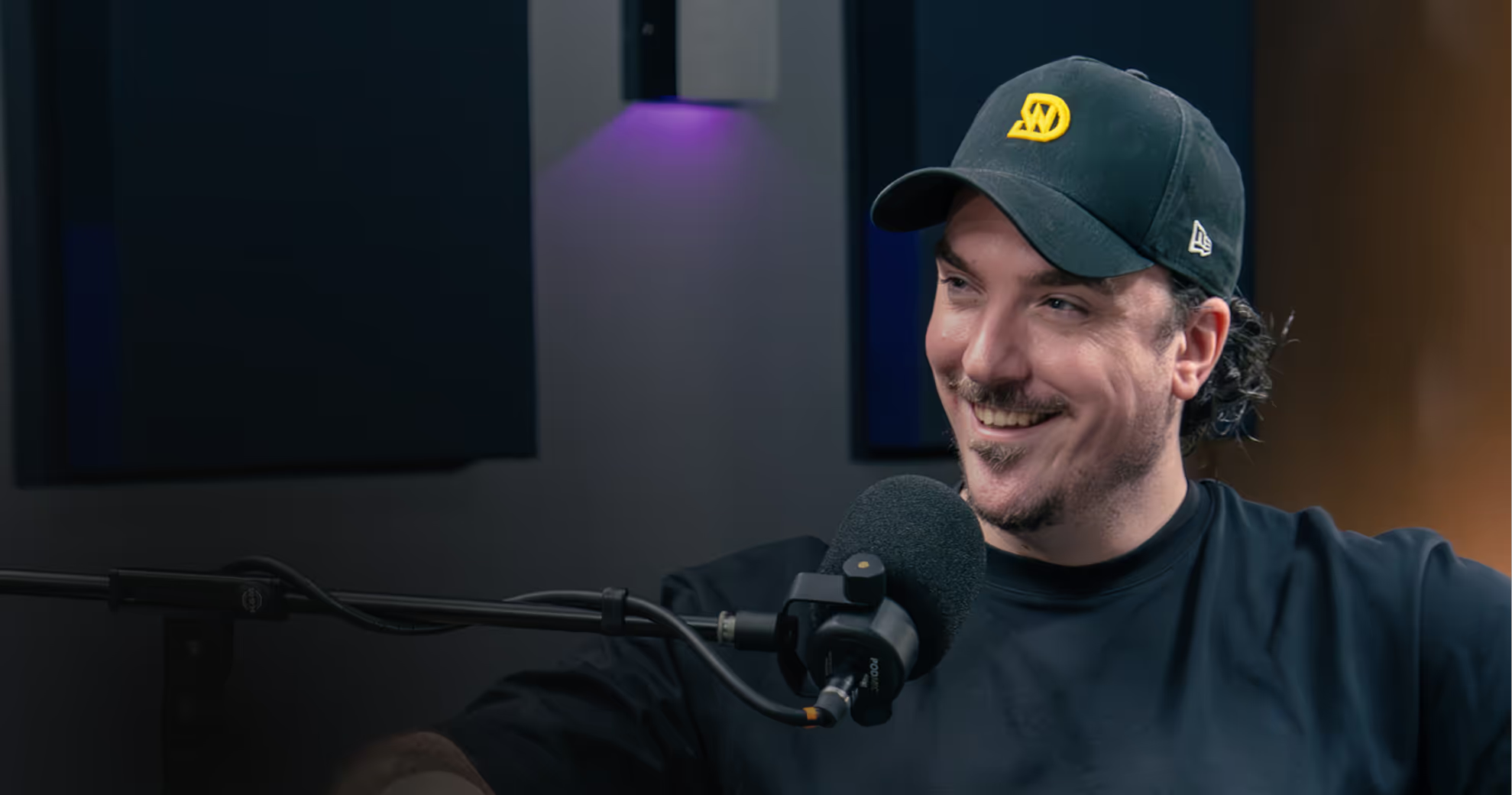
Work With Me

Enquire With Dain’s Team
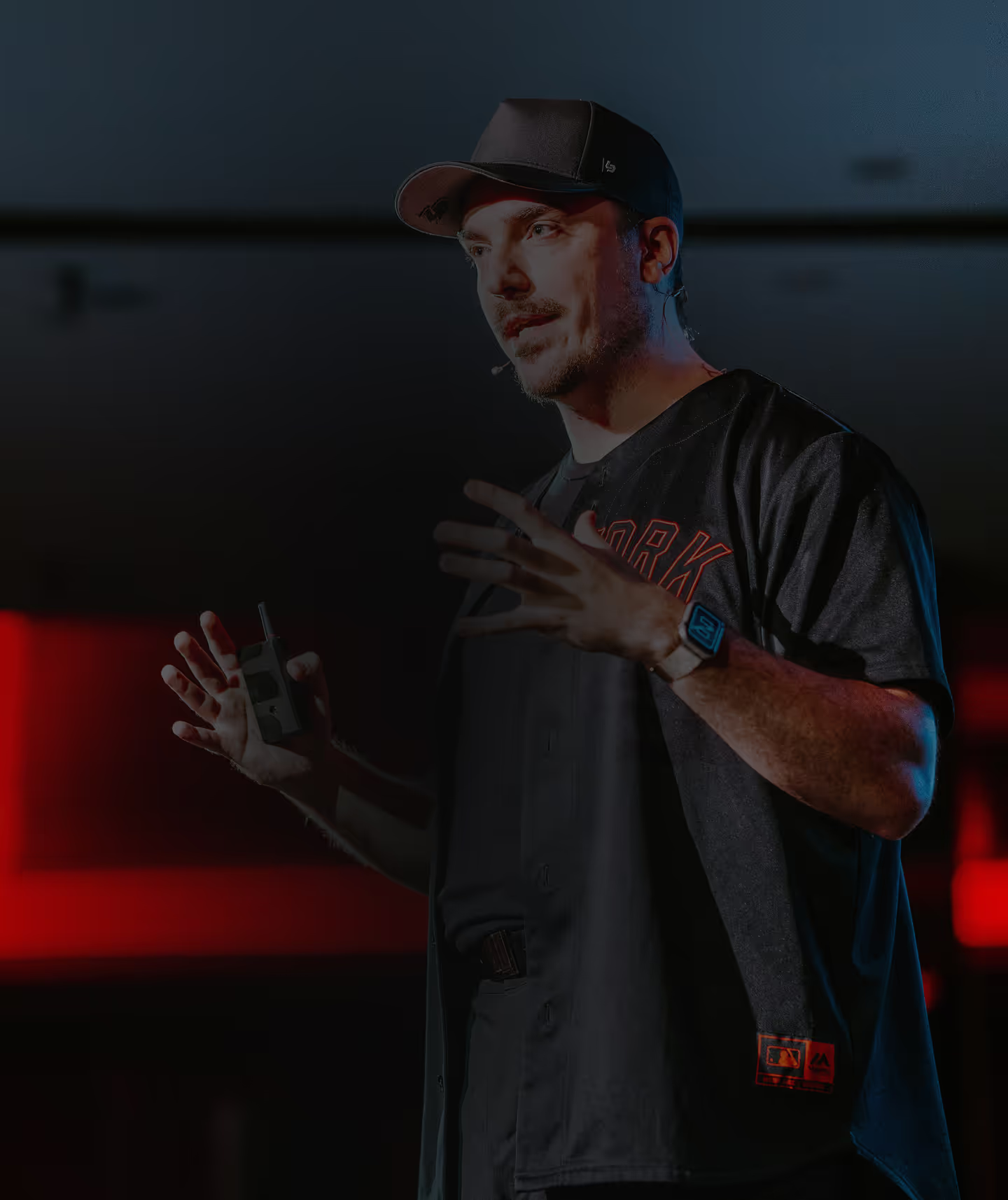
Enquire For Speaking
Let's Get You Branded
Apply to be a guest
Dive into insights from industry leaders and experts.

Stream now
Dive into expert advice and industry trends.